According to which, the declassification of millions of documents from the period of the British Mandate (1920-1948) and Israel’s early days refutes the claim of premeditated dispossession and the consequent creation of the longstanding Palestinian “refugee problem” by Israel.
Wednesday, July 2, 2008
"1948, Israel and the Palestinians"
1948, Israel and the Palestinians, by Efraim Karsh, head of Mediterranean Studies at King's College, University of London. Web-exclusive from Commentary Magazine.
Tuesday, June 24, 2008
Truce? No truce? -- Boy, that was quick.
- Previous cease-fires with Palestinians paint a bleak picture by Abe Selig. Jerusalem Post June 18, 2008:
Aiming to end months of bitter clashes between the IDF and Hamas terrorists in Gaza, a fragile truce has been formally recognized between both Israel and the Hamas-led government there, in which rocket attacks on Israel will stop and Israel will ease its blockade of the Gaza Strip.
But a look at previous tahadiyehs (the Arabic term meaning "period of calm" that Hamas uses for its informal cease-fires) casts doubt on the possibility of a cessation of violence and the likelihood of this latest truce holding at all.
- According to Senior Defense Ministry Official Amos Gilad, one of the conditions of the truce was a cessation to weapons smuggling by Hamas (Ynet News June 19, 2008):
Gilad described the conditions according to which the terror organizations were to be judged during the ceasefire. "We need a total ceasefire – all included. If tomorrow morning one single rocket is fired, it will be a violation of the agreement. There is no room for interpretation, and no mediating body is needed. We will not accept the firing of even one Qassam.
they've already broken it."Egypt, on its side, is committed to preventing the smuggling activity from Gaza. It's simple; Egypt has a border with Gaza, through which weapons and terrorists are smuggled. Smuggling is a serious violation of the terms. Any such infraction will lead to a change in Israel's stance from the way in which it was presented to the Egyptians," he said.
- Rockets hit Israel, breaking Hamas truce International Herald Tribune June 25, 2008:
JERUSALEM: Three Qassam rockets fired from Gaza on Tuesday struck the Israeli border town of Sderot and its environs, causing no serious injuries but constituting the first serious breach of a five-day-old truce between Israel and Hamas, the Islamic group that controls Gaza.
Sunday, June 22, 2008
Latin patriarch Fouad Twal: "it’s time to put an end to the Wall"
According to Vatican Radio, the newly appointed Latin Patriarch Fouad Twal cited "freedom of movement for priests and religious between these regions is a primary pastoral concern":
“We receive a lot of help and we are grateful but at the same time we say we need more. What we need is peace. We don’t only [want] to be a begging Church, we don’t want to be beggars with a licence. I don’t like this. We need a political horizon, it’s time to put an end to the Wall, the Checkpoints, it’s time for a Palestinian State, it’s time for an end to our problems with visa’s. The majority of our priests, nuns, schools, families are in Jordan. We need a link to Jordan we need to be able to move with freedom and liberty for our pastoral work. I am not speaking about politics, let’s leave politics to the politicians, I am a bishop, we want to move for our pastoral work and we are handicapped”.
"Time to put an end to the Wall"? -- Granted that freedom for clergy and religious is a legitimate concern in the administration of their pastoral duties, it is unfortunate that the Archbishop gives little thought to the welfare of those for whom "The Wall" and the "Checkpoints" were established:
Before the construction of the fence, and in many places where it has not yet been completed, a terrorist need only walk across an invisible line to cross from the West Bank into Israel. No barriers of any kind exist, so it is easy to see how a barrier, no matter how imperfect, won't at least make the terrorists' job more difficult. Approximately 75 percent ofthe suicide bombers who attacked targets inside Israel came from across the border where the first phase of the fence was built.Source: Israel’s Security Fence by Mitchell Bard.
During the 34 months from the beginning of the violence in September 2000 until the construction of the first continuous segment of the security fence at the end of July 2003, Samaria-based terrorists carried out 73 attacks in which 293 Israelis were killed and 1950 wounded. In the 11 months between the erection of the first segment at the beginning of August 2003 and the end of June 2004, only three attacks were successful, and all three occurred in the first half of 2003.
Since construction of the fence began, the number of attacks has declined by more than 90%. The number of Israelis murdered and wounded has decreased by more than 70% and 85%, respectively, after erection of the fence.
Even the Palestinian terrorists have admitted the fence is a deterrent. On November 11, 2006, Islamic Jihad leader Abdallah Ramadan Shalah said on Al-Manar TV the terrorist organizations had every intention of continuing suicide bombing attacks, but that their timing and the possibility of implementing them from the West Bank depended on other factors. “For example,” he said, “there is the separation fence, which is an obstacle to the resistance, and if it were not there the situation would be entirely different.”
He said that the second intifada was currently characterized by rocket fire, which had replaced the previous stage of suicide bombing attacks. That, he said, was because the enemy [i.e., Israel ] had found ways and means to protect itself from such attacks: “… For example, they built a separation fence in the West Bank . We do not deny that it limits the ability of the resistance [i.e., the terrorist organizations] to arrive deep within [Israeli territory] to carry out suicide bombing attacks , but the resistance has not surrendered or become helpless, and is looking for other ways to cope with the requirements of every stage [of the intifada]…” (Al-Sharq, March 23, 2008 ).Honestly, I expect the Wall will come down when Israel's enemies decide to abandon their suicide attacks.
Archbishop Fouad Twal appointed new Latin Patriarch of Jerusalem
Archbishop Fouad Twal is the new Latin patriarch of Jerusalem AsiaNews.it June 21, 2008:
Vatican City (AsiaNews) - As of today, Archbishop Fouad Twal is the new Latin patriarch of Jerusalem. Benedict XVI has accepted the resignation presented by His Beatitude Michel Sabbah, whose coadjutor Archbishop Twal has been since 2005.The new patriarch was born in Madaba, in Jordan, on October 23, 1940. In October of 1959, he entered the major seminary of Beit-Jala, and was ordained a priest on June 29, 1966. In September of 1972, he began studies in canon law at the Pontifical Lateran University, and in October of 1974 he entered the ecclesiastical Pontifical Academy. In 1975, he received his degree in canon law.
From 1977 to 1992, he served as a diplomat at the apostolic nunciature of Honduras, the council for public affairs at the Vatican secretariat of state, the apostolic nunciature in Germany, and the apostolic nunciature in Peru.
On May 30, 1992, he was appointed bishop of Tunis, and was ordained on July 22 of the same year. On May 31, 1995, he was made archbishop. He has also been president of the Regional Episcopal Conference of North Africa (CERNA). On September 8, 2005, Benedict XVI appointed him coadjutor for the Patriarchate of Jerusalem of the Latins.
Related
- Msgr. Fouad Twal: “I want to sow the joy of living” - Msgr. Fouad Twal was interviewed by Marie-Armelle Beaulieu (Custody of the Holy Land).
Wednesday, June 18, 2008
Holocaust Survivors meet with Benedict XVI, convey thanks to the Church for saving their lives
Survivors of the Holocaust met with Pope Benedict XVI to convey their gratitude to the Church for saving their lives. Four members of the Pave the Way Foundation met with the Pope this past week -- Zenit News Service reports (June 18, 2008):
Gary Krupp, president of that foundation, told ZENIT: "The Jewish survivors were all very grateful for the opportunity to greet the Pope in German and Italian and to thank him for the intervention of the Roman Catholic Church for saving their lives during World War II."One of the survivors, Ursala Selig, was saved by Monsignor Beniamino Schivo, in those years rector of a seminary in Città di Castello, Italia, and now 97 years old. The monsignor saved Selig along with her mother and father, by shuttling them around to keep them safe, Krupp recounted.
"She spoke of her and her mother dressing like nuns and staying in a convent," Krupp said. "Her father was protected on a little farm eight hours away. She still speaks to Monsignor Schivo twice a week. He was supposed to come but is too frail."
Krupp also presented Benedict XVI with the symposium on the papacy of Pius XII the foundation is preparing for September.
The symposium, he said, aims to reveal "the true hidden story of the dark days of the Holocaust."
Saturday, June 14, 2008
New York Times on Christians for a Fair Witness on the Middle East
Lawyer-Turned-Nun Rises to Israel’s Defense - New York Times profiles the founder of Christians for a Fair Witness:
Sister Ruth Lautt works from a single room on the 19th floor of the God Box. Such is the nickname for the Interchurch Center, the office building on Riverside Drive in Manhattan that is the closest thing to a Vatican for America’s mainline Protestant denominations. Indeed, Sister Ruth’s fellow tenants include agencies of the United Methodist Church, the United Church of Christ and the Presbyterian Church (U.S.A.).
Wearing the tapered suits left over from an earlier career in law and the crucifix of her more recent life as a Roman Catholic nun, Sister Ruth cuts an inconspicuous figure at the elevator bank. And on many of the issues that animate the mainline churches — ecumenical outreach, social justice — she makes a perfectly companionable neighbor. On the subject of Israel, however, she qualifies as something more like the enemy within.
Through the organization she founded three years ago, Christians for Fair Witness on the Middle East, Sister Ruth has frequently and sharply clashed with the very denominations housed under the God Box’s roof. When they have proposed divestment from Israel or more generally condemned its actions against Palestinians, she has fought against those positions, vociferously speaking out for Israel’s right to self-defense and security.
In the rancorous and relentless debate on the Middle East conflict, Sister Ruth stands as a sui generis player. She has little contact with Jewish advocacy groups, none with the American Israel Public Affairs Committee lobby. She disassociates herself from Christian Zionists of the theological and political right. Even while defending Israel’s defensive measures, including the separation barrier, she openly criticizes its occupation of the West Bank and laments Palestinian suffering.
[...]
Little in Sister Ruth’s professional background anticipated her current cause. Before she joined the Dominican order in 1996, she had earned a law degree from New York University and worked at Skadden, Arps. Even after becoming a sister, she continued to litigate cases for a smaller firm on Long Island, close to the Dominican residence where she lived.
Sister Ruth did, however, earn a master’s degree in Jewish-Christian Studies from Seton Hall University in New Jersey, and participated in several ecumenical groups on Long Island.
While she said that she received a divine call to advocate for Israel, that call coincided with a rising tide of protests against Israel for sending its army back into the West Bank’s major cities after a rash of suicide bombings in early 2002. The criticism of Israel from liberal churches grew even greater with construction of the separation barrier, which for portions of its route crosses into Palestinian territory.
Sister Ruth made her first trip to Israel in 2003. (Since then she has returned five times, generally visiting the West Bank as well.) In December 2005, she incorporated Fair Witness and sent out its first news release.
Although the group has a board with Roman Catholic and Protestant members, the operation is essentially all Sister Ruth, all the time. She raises the money for its $120,000 annual budget. She assembled its database on the Israel-Palestine conflict and the positions of mainline Protestant groups. She leads Protestant delegations on study tours to the region — African-American clergy members will be going in August, Lutherans in November — and gives her historical analysis of Zionism and Israel to Christian audiences.
In a typical speech last November at Boston College, she commended the liberal churches for “a wholesome, Gospel-centered concern for Palestinian suffering, which is real,” and endorsed a two-state solution. But she also made the case for Israeli self-defense, even in the form of the separation barrier.
“I need to question how people feel they have the right in the name of peace and justice, to tell other people not to try to preserve their own lives,” she said at one point. “You’re not obligated to lay down and die.”

Sunday, June 8, 2008
Catholics in Israel: an Interview with David Mark Neuhaus, SJ
Zenit News Service interviews Jesuit Father David Mark Neuhaus, secretary-general of the Hebrew-speaking Catholic Vicariate in Israel, known also as the the Association of St. James -- on the history, mission and challenges facing the Hebrew-speaking Catholic community in Israel:
Q: You say on your Web site that being a Hebrew-speaking Catholic community within a predominantly Jewish society is a new experience in the history of the Church. What led to the establishment of the Association of St. James?Father Neuhaus: The Association of St. James that became the Hebrew-speaking Catholic Vicariate was officially established as a part of the Latin Patriarchate of Jerusalem in 1955. This was shortly after the establishment of the state of Israel. It was founded in order to serve the myriads of Catholics who had immigrated to Israel, often within mixed Jewish-Catholic families, and they came predominantly from Europe.
It was also founded as a Catholic presence within Jewish society to nurture a new type of relationship between Catholics and Jews. The new reality of a Jewish state with Hebrew as the official language rendered important the existence of a Catholic milieu in which Hebrew was used and spoken.
Among the founders of the Association were Jews who had become Catholics -- mostly in Europe -- and Catholics -- mostly from Europe -- who had a vocation to live in solidarity with the Jewish people in the state of Israel. Our founding fathers and mothers had a vision of a Hebrew-speaking Catholic community at home within the Jewish people in Israel and living its life of faith in profound dialogue and solidarity with the Jewish people.
Q: What new perspective does a Hebrew-speaking Catholic in the Holy Land have to offer?
Father Neuhaus: A Hebrew-speaking Catholic lives within the only Jewish society that constitutes a majority, where the rhythm of day-to-day life is established by Jewish religion, history and culture. For us, the universal Catholic reflection on the Jewish identity of Jesus and the Jewish roots of our faith is not just one element in our renewal after the Second Vatican Council. It is also part of our daily existence.
Dialogue with Jews here is not with a marginal minority but with the dominant majority. As part of our attempts to inculturate, we are challenged to integrate into our Catholic identity, into our liturgy and into our thinking, this daily encounter with Judaism and the Jewish people.
All of this takes place within the very land that is at the center of the biblical narrative, the land in which biblical Israel, her prophets and Our Lord Jesus walked, taught and lived. ...
Related
- Hebrew-Speaking Catholic Vicariate in Israel
- Dialogue in Jerusalem, by David M. Neuhaus. Addressing the question: How does the Jerusalem context influence dialogue between Jews and Catholics?
Wednesday, June 4, 2008
Why Do Palestinian Terrorist Groups Agree to Cease-Fires?
In the News
- Hamas: We'll accept truce for removing siege, by Kaled Abu Toameh. Jerusalem Post June 3, 2008.
- Israel and Egypt to resume talks on Gaza cease-fire Ha'aretz, Israel - May 24, 2008
“Palestinian terrorist groups agreed to a cease-fire to advance the peace process.”FACT
In an effort to stop the nearly daily onslaught of rockets from Gaza, Israeli officials have discussed the possibility of a cease-fire with the Hamas terrorists bombarding the Israeli civilian population. Egypt and others have also tried to mediate a cessation of terror that would allow Israel to end its counterterror measures. Rather than agree to a simple cease-fire, however, Hamas, has engaged in verbal gymnastics to suggest it will adopt a policy that will, at best, offer a temporary respite while the organization continues to build up its arsenal to pursue its long-term goal of destroying Israel.
The latest example of this Hamas tactic is the proposal in May 2008 to accept a “tahdiyah,” or period of calm. Earlier, in June 2003, Islamic Jihad and Hamas agreed to a hudna in response to demands from then Palestinian Authority prime minister Mahmoud Abbas to stop their attacks on Israel so he could fulfill his obligations under the Middle East road map. The agreement was interpreted in the Western media as the declaration of a cease-fire, which was hailed as a step forward in the peace process. Violence continued after the supposed cease-fire, however, and Israeli intelligence found evidence the Palestinians exploited the situation to reorganize their forces. They recruited suicide bombers, increased the rate of production of Qassam rockets, and sought to extend their range. Over the last five years since the declaration of the hudna, attacks on Israel increased and Hamas succeeded in smuggling in more weapons with longer ranges.
While any cessation of violence against Israeli civilians is to be welcomed, it is important to understand the cease-fire the radical Islamic groups are contemplating in the Muslim context.
The media and some political leaders portray a hudna as a truce or a cease-fire designed to bring peace. Though the term hudna does refer to a temporary cession of hostilities, it has historically been used as a tactic aimed at allowing the party declaring the hudna to regroup while tricking an enemy into lowering its guard. When the hudna expires, the party that declared it is stronger and the enemy weaker. The term comes from the story of the Muslim conquest of Mecca. Instead of a rapid victory, Muhammad made a ten-year treaty with the Kuraysh tribe. In 628 AD, after only two years of the ten-year treaty, Muhammad and his forces concluded that the Kuraysh were too weak to resist. The Muslims broke the treaty and took over all of Mecca without opposition.212
A modern-day hudna is not a form of compromise, rather it is a tactical tool to gain a military advantage. Hamas has used it no fewer than 10 times in 10 years.
Source: Myths & Facts Online -- A Guide to the Arab-Israeli Conflict by Mitchell G. Bard.
See also Mitchell Bard's blog: http://blogs.britannica.com/blog/main/author/mbard.
Sunday, June 1, 2008
Christians for a Fair Witness on the Middle East
Christians for Fair Witness on the Middle East was founded by Sr. Ruth Lautt, O.P., Esq., who serves as its National Director. She is a professed member of the Sisters of the Order of St. Dominic, Congregation of the Holy Cross, Amityville, New York.
Sr. Ruth received a law degree from NYU School of Law and was previously associated with the law firms of Skadden, Arps, Slate, Meagher & Flom and Parcher & Hayes in New York. Prior to founding Fair Witness she was a litigation partner in the Law Firm of Vollmer & Tanck, P.C. in Jericho, New York.
Sr. Ruth has also served on the Ecumenical Commission of the Roman Catholic Diocese of Brooklyn , Catholic-Jewish Dialogue, and the Executive Committee of the National Christian Leadership Conference for Israel. She was previously the Co-Convener of the Five-Towns/Rockaway Interfaith Clergy Council. Sr. Ruth is currently finishing her Masters Degree in Biblical Studies in the Jewish Christian Studies Department at Seton Hall University in New Jersey.
Further Reading: The Church’s Witness on Issues in the Arab/Israeli Conflict, based on a speech given by Sr. Ruth Lautt, O.P., Esq. at Boston College, November 14, 2007.
Vatican, Israel report progress in talks
The plenary meeting of the Bilateral Holy See-Israel Commission to implement the Fundamental Agreement signed 15 years ago ended today in the Vatican after making “real progress", reports AsiaNews.it:
Reports indicate that all participants came out of the meeting with “cautious satisfaction”.Although it is not known what was discussed, from the start the Church has called on Israeli authorities to recognise its historic tax exemptions as well as return Church properties lost over the years.
The Commission decided that its next meeting will take place in December. The recent round of negotiations comes after five years of deadlock. They began with a meeting on 21 May 2007, followed by another on 13 December 2007, and then today’s session.
With the next plenary meeting scheduled for December in Jerusalem, the Commission now seems set to meet on a regular basis, twice a year.
Background Reading: Israel-Vatican Relations & The Fundamental Agreement February 12, 2007.
Friday, May 16, 2008
Israeli Ambassador on "smoothing things up" with the Vatican
John Thavis interviews Israeli Ambassador to the Vatican Mordechai Lewy on his recent appointment, which he describes as "smoothing things up and not for stressing the corners" (Catholic News Service. May 16, 2008):
ROME (CNS) -- Israeli ambassadors to the Vatican have a tradition of being press-friendly, and Mordechay Lewy is no exception.Ambassador Lewy also took the opportunity to address some questions regarding the status of Christians in the Holy Land and concerns expressed over their freedom of passage:Three days after presenting his credentials to Pope Benedict XVI, Lewy sat down with six Vatican journalists for a conversation at the Israeli Embassy in Rome's Parioli neighborhood.
Over coffee and cookies May 15 he chatted about his new job and did a little parsing of the pope's speech, which was handed to him at the credentials ceremony.
Lewy left no doubt that he relishes the role of ambassador to the Holy See. He said that when diplomatic relations between the Vatican and Israel were established in 1993 he told himself, "That's a job for me." He's had a long interest in the history of religion in the Middle East. ...
One church complaint in recent years has been a tightening of entry visas for church personnel working in Israeli territory. Lewy said the stricter policy was the result of the many suicide bombings during the second intifada that began in 2000.The ambassador said Eastern churches in the Holy Land often have personnel coming from countries like Syria, Iraq and Lebanon, so they are going to be carefully checked. Those whose job it is to protect the country view it simply as a security issue, he said.
"I see a clergyman. The security supervisor sees a Syrian," he said.
When it was pointed out that Christians have not carried out suicide bombings, the ambassador recalled the case of Melkite Archbishop Hilarion Capucci, a Syrian prelate arrested by Israel in 1974 and charged with running guns for terrorists but freed under Vatican pressure.
"It was a long time ago, but this remains in the collective memory. It did a lot of harm," Lewy said.


Thursday, May 15, 2008
President Bush: "Our friendship ... is grounded in the shared spirit of our people, the bonds of the Book, the ties of the soul."
The alliance between our governments is unbreakable, yet the source of our friendship runs deeper than any treaty. It is grounded in the shared spirit of our people, the bonds of the Book, the ties of the soul. When William Bradford stepped off the Mayflower in 1620, he quoted the words of Jeremiah: "Come let us declare in Zion the word of God." The founders of my country saw a new promised land and bestowed upon their towns names like Bethlehem and New Canaan. And in time, many Americans became passionate advocates for a Jewish state.- From an Address by President George W. Bush at the Knesset, honoring the 60th Anniversary of Israel. May 15, 2008.
Centuries of suffering and sacrifice would pass before the dream was fulfilled. The Jewish people endured the agony of the pogroms, the tragedy of the Great War, and the horror of the Holocaust -- what Elie Wiesel called "the kingdom of the night." Soulless men took away lives and broke apart families. Yet they could not take away the spirit of the Jewish people, and they could not break the promise of God. (Applause.) When news of Israel's freedom finally arrived, Golda Meir, a fearless woman raised in Wisconsin, could summon only tears. She later said: "For two thousand years we have waited for our deliverance. Now that it is here it is so great and wonderful that it surpasses human words."
The joy of independence was tempered by the outbreak of battle, a struggle that has continued for six decades. Yet in spite of the violence, in defiance of the threats, Israel has built a thriving democracy in the heart of the Holy Land. You have welcomed immigrants from the four corners of the Earth. You have forged a free and modern society based on the love of liberty, a passion for justice, and a respect for human dignity. You have worked tirelessly for peace. You have fought valiantly for freedom.
My country's admiration for Israel does not end there. When Americans look at Israel, we see a pioneer spirit that worked an agricultural miracle and now leads a high-tech revolution. We see world-class universities and a global leader in business and innovation and the arts. We see a resource more valuable than oil or gold: the talent and determination of a free people who refuse to let any obstacle stand in the way of their destiny.
I have been fortunate to see the character of Israel up close. I have touched the Western Wall, seen the sun reflected in the Sea of Galilee, I have prayed at Yad Vashem. And earlier today, I visited Masada, an inspiring monument to courage and sacrifice. At this historic site, Israeli soldiers swear an oath: "Masada shall never fall again." Citizens of Israel: Masada shall never fall again, and America will be at your side.

Tuesday, May 13, 2008
Irena Sendler 1910-2008: "Righteous Among the Nations"
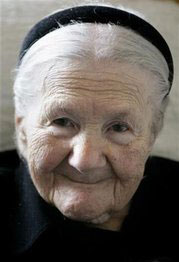 |
Irena Sendler, a Roman Catholic who created a network of rescuers in Poland who smuggled about 2,500 Jewish children out of the Warsaw ghetto in World War II, some of them in coffins, died Monday in Warsaw. She was 98.The death was confirmed by Stanlee Stahl, executive vice president of the Jewish Foundation for the Righteous, an organization that supports rescuers of Holocaust victims.
Mrs. Sendler was head of the children’s bureau of Zegota, an underground organization set up to save Jews after the Nazis invaded Poland on Sept. 1, 1939. Soon after the invasion, approximately 450,000 Jews, about 30 percent of Warsaw’s population, were crammed into a tiny section of the city and barricaded behind seven-foot-high walls.
On April 19, 1943, the Nazis began what they expected would be a rapid liquidation of the ghetto. It took them more than a month to quell the Warsaw ghetto uprising. By then, only about 55,000 Jews were still alive; most of them were sent to death camps.
Also by then, however, Mrs. Sendler’s group of about 30 volunteers, mostly women, had managed to slip hundreds of infants, young children and teenagers to safety.
“She was the inspiration and the prime mover for the whole network that saved those 2,500 Jewish children,” Debórah Dwork, the Rose professor of Holocaust history at Clark University in Massachusetts, said Monday. Professor Dwork, the author of “Children With a Star” (Yale University Press, 1991), said about 400 children had been directly smuggled out by Mrs. Sendler. ...
The Wikipedia entry has further details:
In December 1942, the newly created, the newly created Children's Section of the Żegota (Council for Aid to Jews), nominated her (under her cover name Jolanta) to head its children's department. As an employee of the Social Welfare Department, she had a special permit to enter the Warsaw Ghetto, to check for signs of typhus, something the Nazis feared would spread beyond the ghetto. During the visits, she wore a Star of David as a sign of solidarity with the Jewish people and so as not to call attention to herself.[Sendler] cooperated with the Children's Section of the Municipal Administration, linked with the RGO (Central Welfare Council), a Polish Relief Organization tolerated under German supervision. She organized the smuggling of Jewish children from the Ghetto, carrying them out in boxes, suitcases and trolleys. The children were placed with Polish families, the Warsaw orphanage of the Sisters of the Family of Mary or Roman Catholic convents such as the Sisters Little Servants of the Immaculate Conception of the Blessed Mary at Turkowice and Chotomów. Some were smuggled to priests in parish rectories where they could be further hidden. She kept lists of the names, hidden in jars, in order to keep track of their original and new identities.
Arrested in 1943 by the Gestapo, she was severely tortured and sentenced to death. The Żegota saved her by bribing the German guards on the way to her execution. She was left in the woods, unconscious and with broken arms and legs. Officially, she was listed on public bulletin boards as among those executed. Even in hiding, she continued her work for the Jewish children.
Related
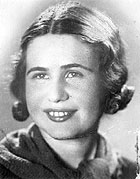 Life in a Jar: The Irena Sendler Project - a website by rural Kansas school students who -- initially skeptical about the claim to have saved 2,500 children -- started a research project:
They found that Irena Sendler, as a non-Jewish social worker, had gone into the Warsaw Ghetto, talked Jewish parents and grandparents out of their children, rightly saying that all were going to die in the Ghetto or in death camps, taking the children past the Nazi guards (in body bags, saying they were ill, or using one of the many means of escape from the Ghetto-the old courthouse for example), and then adopting them into the homes of Polish families or hiding them in convents and orphanages. She made lists of the children's real names and put the lists in jars, then buried the jars in a garden, so that someday she could dig up the jars and find the children to tell them of their real identify.
The Nazi's captured her and she was beaten severely, but the Polish underground bribed a guard to release her, and she entered into hiding. The students wrote a performance (Life in a Jar) in which they portrayed the life of Irena Sendler. They have performed this program for numerous clubs and civic groups in the community, around the state of Kansas, all over the U.S. and in Europe (225 presentations as of November 2007). The community of Uniontown has little diversity and no Jewish students in the school district. The community was inspired by the project and sponsored an Irena Sendler Day. The students began to search for the final resting place of Irena and discovered she was still alive and living in Warsaw, Poland. Irena's story was unknown world-wide, even though she has received esteemed recognition from Yad Vashem in the 1960's and support from the Jewish Foundation for the Righteous in New York City. Forty-five years of communism had buried her story, even in her own country.
From that time on they would take a jar to every performance and collect fund for Irena and other Polish rescuers. ...
- A TV movie about the life of Holocaust hero Irena Sendler is being readied for production and will air next season on CBS:
"The Irena Sendler Story" is based on an authorized biography of the woman credited with rescuing some 2,500 Jewish children from the Nazis by smuggling them out of the Warsaw Ghetto, producer Hallmark Hall of Fame said Monday. ...
John Kent Harrison, who became familiar with Sendler's bravery while in Poland three years ago filming a CBS miniseries about Pope John Paul II, wrote the script for the Sendler film and will direct.
The movie is drawn from the 2005 book "Mother of the Children of the Holocaust: The Irena Sendler Story," written by Anna Mieszkowska.
- I'm no hero, says woman who saved 2,500 ghetto children The Guardian March 15, 2007:
Mrs Sendlerowa, who is in a Warsaw nursing home, insisted she did nothing special.
In an interview she said: "I was brought up to believe that a person must be rescued when drowning, regardless of religion and nationality."
"The term 'hero' irritates me greatly. The opposite is true. I continue to have pangs of conscience that I did so little."
- Irena Sendler Tribute by Yad Vashem ("The Righeous Among the Nations").
Monday, May 12, 2008
Pope Receives Israeli Ambassador, Asks Israel to Aid Catholics
Pope Benedict XVI received Monday Israel's new Vatican ambassador, expressing the need for a 'just peace' to resolve the conflict between the Jewish state and the Palestinians:
Mordechay Lewy presented his credentials to the pontiff at a ceremony in the Vatican.See also: Pope asks Israel to aid Catholics YNet News. May 12, 2008.'The Holy See joins you in giving thanks to the Lord that the aspirations of the Jewish people for a home in the land of their fathers have been fulfilled, and hopes soon to see a time of even greater rejoicing when a just peace finally resolves the conflict with the Palestinians,' Benedict said.
The Vatican recognized Israel's 'legitimate need for security and self-defence', in the same way that it believed that all people should have a right to be given equal opportunities to flourish,' the pontiff told Lewy.
'Accordingly, I would urge your government to make every effort to alleviate the hardship suffered by the Palestinian community, allowing them the freedom necessary to go about their legitimate business, including travel to places of worship, so that they too can enjoy greater peace and security,' Benedict said.
The pontiff also offered his 'good wishes' for the 60th anniversary of the founding Israel which is being celebrated this year.
He also recalled the establishment in 1993 of diplomatic relations between Israel and the Vatican.
Tuesday, May 6, 2008
Pakistani Christians - Praying for Israel and a right to Pilgrimage
Pakistani Christians praying for Israel which Islamabad ought to recognise AsiaNews.it:
Karachi (AsiaNews) – Christians across Pakistan are praying for the 60th anniversary of the founding of the State of Israel in the hope that one day Islamabad and Tel Aviv may establish diplomatic relations and allow them to go on pilgrimage to the Holy Land, said Asharf P. Butt, president of the Association of Pakistani Christians, at a press conference in Karachi organised to express best wishes for Israel and its population.The organisation “demanded once again that the government of Pakistan recognise Israel and normalise diplomatic relations,” Asharf said, “not only as a question of international justice but also to allow Pakistan’s ten million Christians to make a pilgrimage in the land of the Bible.”
Christians in Pakistan “have a long-standing dream, to visit this land but cannot because of the current diplomatic situation,” he said. “This means that we are deprived of our religious rights. Hence we shall pray in all of Pakistan’s churches for peace and protection for the holy city of Jerusalem.”
Thursday, April 17, 2008
Israeli-Vatican Relations: Update from the Bilateral Permanent Working Commission
Cordiality & trust mark Holy See/Israel relations, by Arian Cohen. Spero News. April 17, 2008. Emerging from the Bilateral Permanent Working Commission is a renewed commitment by Israel and the Holy See to accelerate the conclusion of an agreement. Among the objectives is the restitution of the site of the Last Supper. Meeting set for May 28.
Tuesday, December 4, 2007
The End of Christianity in Palestine?
Expert: 'Christian groups in PA to disappear', by Etgar lefkovits. Jerusalem Post December 4, 2007:
The ever-dwindling Christian communities living in Palestinian-run territories in the West Bank and Gaza are likely to dissipate completely within the next 15 years as a result of increasing Muslim persecution and maltreatment, an Israeli scholar said Monday.(Via Deal Hudson)."The systematic persecution of Christian Arabs living in Palestinian areas is being met with nearly total silence by the international community, human rights activists, the media and NGOs," said Justus Reid Weiner, an international human rights lawyer in an address at the Jerusalem Center for Public Affairs, where he serves as a scholar in residence.
He cited Muslim harassment and persecution as the main cause of the "acute human rights crisis" facing Christian Arabs, and predicted that unless governments or institutions step in to remedy the situation - such as with job opportunities - there will be no more Christian communities living in the Palestinians territories within 15 years, with only a few Western Christians and top clergymen left in the area. . . . [read more]
Worth reading: The Beleaguered Christians Of The Palestinian-Controlled Areas, by David Raab.
Monday, August 27, 2007
Poetic Justice
The ultimate betrayal? Son of Nazi Embraces Judaism (Jewish World Review August 21, 2007):
Bernd Wollschlaeger has two stories to tell.Good one. Here's another from last year: Matthias Göring Goes Kosher (Der Spiegel May 10, 2006):First, he's a former officer in the Israel Defense Forces, a physician who developed expertise in biological warfare. He lives in Miramar, Florida, runs a family practice in North Miami Beach, has become a legislative leader of the American Medical Association and is active in local Jewish causes.
Now, at 49, he has decided to tell "my coming-out story."
It is this: He was born the Christian son of a World War II German tank commander — a third-generation warrior who received Deutschland's highest military honor, the Iron Cross, which was pinned on his uniform by Adolf Hitler himself. . . .
Mr. Göring is determined to discover the origin of the wine we're drinking. The waiter, an old man with snow white hair and a dark blue kippa, toddles over and says: "It's from a small vineyard near Haifa, Sir." Göring leans back in his chair, satisfied. "Ah, Israeli wine," he sighs, "Perfect."That's Matthias Göring, not Hermann. Even so, it is very odd to be having lunch in a Jewish restaurant with a direct descendent of Adolf Hitler's right-hand man. Matthias Göring, though, couldn't be happier here. After 44 years of "despising Jews" and suffering the curse of his family name, the 49-year-old physiotherapist has become a full-on Israel lover. He wears a kippa, keeps kosher, celebrates Shabbat, is learning Hebrew and is even considering converting. His family thinks he has gone mad.
"They think I've got a screw loose," grins the man who now works with the victims of suicide bombings. "But I know what has happened to me is completely and utterly real."
Monday, February 12, 2007
Israel-Vatican Relations & The Fundamental Agreement
On December 30, 1993, the Fundamental Agreement was signed by Msgr. Claudio Celli, Vatican assistant secretary of state and Israel's deputy minister of foreign affairs, Yossi Beilin, paving the way to full diplomatic relations between the two parties in 1994: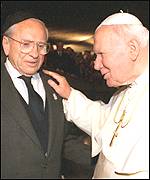 John Paul II's greetings to Israel in celebration of their new year appears to have sprung from a collaboration with his lifelong friend Jerzy Kluger, who played a subtle yet instrumental role (at the Pope's request) in facilitating communication between Israel and the Vatican (How a Pope's Boyhood Friend Helped Forge Ties to Israel):
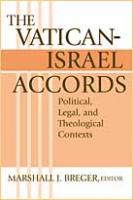 The Vatican-Israel Accords: Political, Legal, and Theological Contexts, edited by Marshall J. Breger. University of Notre Dame Press (February 2004). [Contents].
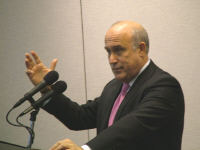
The Fundamental Agreement extends the theological advances of Nostra Aetate into the political realm, creating for the first time formal diplomatic relations between the Holy See and the State of Israel. The Agreement signifi es a historic step in the evolution of the Roman Catholic Church’s attitude toward Judaism and the Jewish People.[Source: Milestones in Israel-Holy See Relations 1993-2005: Commemoration of the 40th Anniversary of Nostra Aetate Consulate General of Israel in New York].The Fundamental Agreement addresses three spheres of relations: 1) political relations between Israel and the Holy See; 2) relations between the Jewish People and the Catholic Church; and 3) relations between the State of Israel and the Roman Catholic Church.
In 1997 the "Legal Personality" Agreement between the State of Israel and the Holy See was signed:
[regularizing] the status and legal personality of the Roman Catholic Church and its institutions under Israeli law, after approximately 500 years of undefined legal status under Ottoman Empire, the British Mandate, and Israeli sovereignty.This agreement marks the first de jure recognition of the Roman Catholic Church by any government in the Holy Land. It bestows upon the Roman Catholic Church the autonomy to run its internal affairs, subject to Israeli law in interaction with other bodies. The Legal Personality Agreement constitutes a continuation of the Fundamental Agreement of 1993.
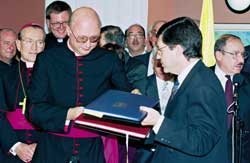 In an exclusive article, The ten years of the Fundamental Agreement 30 Giorni ["30 Days"] No. 12, 2003, Israeli statesman Yossi Beilin describes the "behind the scenes" discussions which led to the signing:
These were open talks, launched at the Vatican’s initiative in the summer of 1991, even before the Madrid Conference. It was Archbishop Andrea Cordero Lanza di Montezemolo, the apostolic delegate in Jerusalem, who announced the Vatican’s intention to initiate negotiations on an agreement with Israel, and he did so in consultation with Dr. David Jaegar, an Israeli Jew who had become a Franciscan priest, with boasted special knowledge in Canon Law.The initial probes between Israel and the Vatican revealed the main dispute between them: Israel wanted to reach, first of all, an agreement on diplomatic relations between the two states, and only subsequently to discuss questions such as the freedom of religion, Church taxation, education, etc. The Vatican wanted to deal with all the practical matters, and to remove – at least at the first stage – the matter of the diplomatic relations from the agenda. . . .
Each party came to the table with its own priorities -- for Israel, the objective was (understandably) "the common war on anti-Semitism and unequivocal recognition of the State of Israel." For the Church, the concern lay with the rights of Catholics residing in the State of Israel:
. . . the guarantee of freedom of worship for Catholics, the legal status of priests, and the special approach of Pope John Paul II, who, as early as 1981, had sent to the President of the State of Israel a blessing for the New Year, and in 1986, had visited the synagogue in Rome – symbolic acts which stressed – alongside a long list of other acts – his special deep respect for Israel and its people.
John Paul II's greetings to Israel in celebration of their new year appears to have sprung from a collaboration with his lifelong friend Jerzy Kluger, who played a subtle yet instrumental role (at the Pope's request) in facilitating communication between Israel and the Vatican (How a Pope's Boyhood Friend Helped Forge Ties to Israel):When the Archbishop was named Pope in 1978, he stunned the world by granting his first papal audience, or formal reception, to Mr. Kluger and his family.(Pope John Paul II and Jerzy Kluger's friendship was made the subject of Darcy O'Brien's The Hidden Pope: The Untold Story of a Lifelong Friendship (Roedale Books, 1998).Three years later, the Pope was wounded in an assassination attempt. On Mr. Kluger's third visit to the Pope in the hospital, the Pope suggested that with the Camp David accords pointing the way for peace in the Middle East, it was time for the Vatican to consider opening diplomatic channels to Israel.
"Are you willing to help?" Mr. Kluger says the Pope asked him. "We must proceed cautiously, officially and unofficially."
Mr. Kluger played the role of broker and host, inviting Israeli and Vatican representatives to dine at his tennis club in Rome and playing bridge with key Cardinals. The steps were often small and symbolic. Once he relayed an Israeli diplomat's suggestion that the Pope send a telegram with Jewish New Year greetings to the President of Israel. The Pope sent the telegram.
In 1994, at the ceremony welcoming the first Israeli Ambassador to the Holy See, Mr. Kluger stood for photographs next to the Pope, sandwiched between Israeli and Vatican dignitaries.
"I was a friend," Mr. Kluger said. "And we had friendly conversations, and friendly relationships which one way or another helped these developments. That's all."
Related Commentary on The Fundamental Agreement
- In Israel-Vatican Relations Since the Signing of the Fundamental Agreement, Rabbi David Rosen discusses some of the conceptual conceptual hurdles that were tackled in the process of formalizing the Fundamental Agreement and Israeli-Catholic relations since its signing in 1993. [Microsoft Word - printable format]:
. . . as the Preamble of the Agreement indicates, the accord took place within the wider context of Catholic-Jewish reconciliation on which it undoubtedly had a profoundly positive impact in turn. Indeed, for many Jews especially in Israel, the diplomatic normalization served as testimony and proof of the genuineness of the transformation in theological attitudes and teaching that had taken place over the previous thirty years. The third relationship addressed by the majority of the articles in the Fundamental Agreement, concerns the relationship between the Catholic Church in Israel and the State.
Rosen's article was published in the anthology The Vatican-Israel Accords: Political, Legal, and Theological Contexts, edited by Marshall J. Breger. University of Notre Dame Press (February 2004).While Israel's goal was essentially the first of these3, the Holy See's primary interest concerned the third. Indeed this difference reflects the divergent perceptions of the principle purpose of the bilateral relations.
- Israel's Relations with the Vatican by Aharon Lopez (former Israeli ambassador to Vatican). No. 401 13 Adar 5759 / 1 March 1999. Jerusalem Center for Public Affairs:
The establishment of diplomatic relations between Israel and the Holy See is not to be considered as a point of arrival, but rather as a starting point. We are climbing up a mountain together and, from time to time, we reach important and substantial milestones towards the mountain's peak.
In closing, let me share with you a very significant event which I cherish close to my heart. At the beginning of my mission as Ambassador to the Holy See, I received a fax from an Israeli Christian Arab who requested my help in asking the Pope to baptize his son. He and his wife were especially keen in seeing their wish fulfilled because, sadly, they had experienced the tragic loss of their first son.
Knowing that there are "only" 989 million Catholics all over the world, I feared we might have some difficulties in fulfilling such a request. Nevertheless, I contacted the proper authorities in the Vatican and emphasized that during the presentation of my credentials I had assured the Pope that I am representing all Israeli citizens--Moslems, Christians, and Jews alike--and therefore it was my duty to submit this request on behalf of a Christian citizen of Israel.
I was very pleased, a few weeks later, to receive a positive answer. Indeed, the Pope agreed to conduct the ceremony in his private chapel. I will never forget the smile on the face of the boy's parents after their dream came true.
The Vatican-Israel Accords: Political, Legal, and Theological Contexts, edited by Marshall J. Breger. University of Notre Dame Press (February 2004). [Contents].Published during the tenth anniversary year of The Fundamental Agreement, The Vatican-Israel Accords brings together essays that analyze the legal, historical, theological, and political meaning of the Accords.
The compelling essays in this collection explore not only the document and events surrounding its signing, but also the past, present, and future of Catholic-Jewish relations. Contributors, who include scholars from Israel, Italy, France, Spain, and the United States, contend that the history and structure of the Accords offer lessons that may be instructive for others involved in seeking peaceful resolutions to conflict, particularly those who work for peace between Palestine and Israel.
Contributors: Marshall J. Breger, Laurenzo Cremonesi, Msgr. Richard Mathes, David-Maria A. Jaeger, O.F.M., Leonard Hammer, Silvio Ferrari, Rafael Palomino, Msgr. Roland Minnerath, Rabbi David Rosen, Moshe Hirsch, Geoffrey Watson, Giorgio Filibeck, Ruth Lapidoth, Fr. Drew Christiansen, S.J., and Rabbi Jack Bemporad.
MARSHALL J. BREGER is professor of law at the Columbus School of Law, Catholic University of America.
Reviews "The Vatican-Israel Accords promises to make a tremendous contribution to understanding a tangled relationship. It is a unique, and uniquely valuable, volume." --George Weigel, Ethics and Public Policy Center, Washington, D.C.
Israeli-Catholic relations since the 1993 signing have not always gone smoothly. Sandro Magister reported on two impediments to Israeli-Vatican relations and the subsequent implementation of the Vatican-Israel accords (with regards to financial issues and the status of Church property) in 2005:
The first skirmish came on July 12. That day, John Paul II was commemorated in the Israeli parliament, the Knesset. And on that occasion, apostolic nuncio Pietro Sambi delivered a speech that was reprinted in its entirety by "L'Osservatore Romano" six days later.For further analysis on Pope Benedict's 2005 omission of Israel from a list of recent victims of terrorism, I refer to John Allen Jr.'s "Context crucial in Vatican-Israel uproar" (National Catholic Reporter, August 12, 2005).In the speech, Sambi complained about Israel's failure to take practical measures to implement the accords with the Holy See reached in 1993 and 1994:
"The Fundamental Agreement, which was ratified by the state of Israel on February 20, 1994, and is recognized internationally, has not yet been incorporated into Israeli law by the Knesset. The same must be said of the Legal Personality Agreement ratified by Israel on December 16, 1998, and recognized internationally on February 3, 1999. The so-called 'Economic Agreement', prescribed by article 10 of the Fundamental Agreement, has not yet been concluded."
A meeting between the two parties to discuss the application of these agreements had been planned for July 26. But the meeting never took place, to the great disappointment of the Holy See and the Catholic community in the Holy Land.
On the day the ceremony was taking place in the Knesset, on July 12, Islamic terrorists carried out a serious attack in Netanya.
But at the Sunday Angelus on July 24, Benedict XVI did not mention Israel as being among the countries recently struck by terrorist attacks: Egypt, Turkey, Iraq, Great Britain.
Exploiting this omission, the next day the Israeli foreign minister summoned the Vatican nuncio, Pietro Sambi, to communicate a note of protest [...]
After some tit-for-tat jousting between diplomats, Israeli Prime Minister Ariel Sharon moved to resolve any ill-feelings with the Vatican in a personal letter ("Israel, Vatican mend fences after dispute over pope's terrorism comments", by Arial David. World Wide Religious News August 27, 2005):
In his letter, Sharon said Benedict's efforts to promote dialogue with Jews and Israel made him "a true friend of Israel, genuinely committed to advancing tolerance, understanding and reconciliation," Ben Hur said in a phone interview, reading from the letter. He said Sharon then explained the reasons for his country's reaction to the omission."Israel has been devastated and victimized by terrorism, and we are very sensitive to any attempt to distinguish between Islamic terrorism which systematically targets innocent Israeli civilians and that which is aimed at citizens of other countries," Sharon wrote.
Sodano expressed his satisfaction with the letter during Tuesday's meeting, saying both sides had made mistakes and that he was happy to put the issue behind him, Ben Hur said. The letter also invited Sodano to visit Israel.
In August 2006, Magister also featured an interview with Israeli ambassador Oded Ben Hur, in which he commmented further on Israel's perception of Pope Benedict and Israel's expectations of Rome:
In mid-July, just when the war had broken out in Lebanon, [Oded] was deeply troubled by the first statements from the Vatican authorities: “All of them went the same way, against Israel. The true aggressor, Hezbollah, wasn’t even mentioned by name. But after this the judgments became more balanced.”Q: Did this happen when Benedict XVI began speaking out personally?
A: I would go so far as to say that Benedict XVI looks at Israel from a different point of view, compared to others. He sees the state of Israel not as an error of history, but as the heart of the Jewish world, a heart that by right should beat in Jerusalem. At the same time he is a realistic pope, who understands that the Church’s political influence is limited. He knows that the Church’s strength is not political, but moral. And it is there that he exerts himself most. It’s the pope as the great educator of the world, reawakening consciences, illuminating the darkness of ignorance, and pointing out where evil is triumphing over the good.
Q: The Middle East is one of the places where evil abounds the most.
A: And it may be that today the international community is taking greater notice of this. What happened in Lebanon was not the rupture of a situation of peace. Peace wasn’t there before this war. In that country there was a cancer named Hezbollah, a state within the state, which held the civil population hostage and fought a war while using this population as a shield. Even today, after the ceasefire, Hezbollah says it does not at all consider the war to be over, and is refusing to disarm. And Hamas continues to launch Kassam rockets against Israeli cities. [...]
Q: What is expected from the Church of Rome?
A: A great deal. In Lebanon there is a strong Christian community that can act as a bridge for peace. The pilgrims to the holy places, when they come in great numbers, are also helpful to the local populations. I also have an idea that I have already proposed to the Vatican authorities: that of creating a task force with representatives from the three religions – Christianity, Judaism, and Islam – who would travel throughout the various countries of the Middle East spreading a message of reconciliation, in order to sensitize and mobilize those who sincerely desire peace, and separate them from extremist and violent groups.
In December of 2006 Israeli Prime Minister Ehud Olmert met with Pope Benedict XVI (Catholic News Service Dec. 14, 2006) - among the topics of discussion was the "dwindling Catholic population in the Holy Land, including in Bethlehem," and peace in the Middle East:
Ben-Hur said Pope Benedict thanked the prime minister for Israeli's declaration of a cease-fire with Palestinian militias, although Ben-Hur said the prime minister said it is getting more and more difficult "to withhold reactions" to missiles being launched into Israel from Gaza.Ben-Hur said that when Olmert renewed a government invitation for the pope to visit Israel, the pope said he really wanted to make such a trip, but was looking for "a moment of calm."
"The prime minister told him, 'You can bring the calm,'" the ambassador said.
Talks between Israel and the Vatican resumed in 2007 with the goal of applying the provisions of the Fundamental Agreement's over the holy places, the Church‘s properties, and finances. In Holy See-Israel: painstaking resumption of negotiations (AsiaNews.it Bernardo Cervellera, December 12, 2006), Oded Ben Hur gave another interview on the nature of the impediments to negotations.
Related Resources
- Franciscan Custody of the Holy Land, the institution that cares for the property of the Catholic Church in Israel and the Territories.
- Catholic Friends of Israel, founded by Don Kenner. I came into contact with Mr. Kenner shortly after the Israeli-Hezbollah conflict in July-August 2006 and have become an occasional contributor to their blog. To learn about the founder of CFOI, I recommend this interview with IsraPundit; see also "The Bishops and the Suicide Bomber" FrontPageMag January 28, 2004).
- Christians for Fair Witness on the Middle East, founded by Sr. Ruth Lautt, O.P., Esq., advocates among mainline Protestants and Roman Catholics in North America for fairness in the churches’ witness on issues related to the conflict between Israel and its Arab neighbors.
- Milestones in Israel-Holy See Relations 1993-2005: Commemoration of the 40th Anniversary of Nostra Aetate Consulate General of Israel in New York.
- Pave The Way Foundation "dedicated to achieving peace by bridging the gap in tolerance and understanding, between religions through cultural, technological and intellectual exchanges." Gary Krupp, the founder, was promoted to the highest Pontifical Order of St. Gregory the Great -- the first Jewish man to be knighted by two popes.
Updates
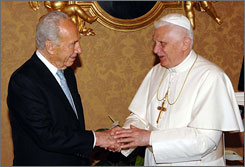 On September 9, 2007, Shimon Peres, in his first foreign visit as president of Israel, met with Pope Benedict at Castel Gandolfo and members of the Vatican curia, to discuss Catholic-Israeli relations and the situation in the Middle East. AsiaNews.it reports:
Rome (AsiaNews) – The Israeli President Shimon Peres is “quite optimistic” regarding negotiations between Israel and the Holy See and has declared that “within the years end the most important problems will be resolved”. Answering a question put forward by AsiaNews, during a press conference, he also said that he had invited Benedict XVI to visit Israel. ...
On the long standing question of the implementation of the Fundamental Agreement, 13 years on from its signing, the Holy See statement urges “a rapid conclusion to the important ongoing negotiations and the beginning of a constant dialogue with Israeli Authorities and local Christian communities, in view of their participation in working for the common good”.
September 3 last –after a long summer pause – and after years of deadlock, negotiations between the Holy See and Israel recommenced. They aim to lead to an agreement regarding issues of taxation and Church properties, which have been waiting implementation since ’93.
The Vatican statement makes no reference whatsoever to a possible visit by Benedict XVI to Israel, even if the pope has already expressed a positive opinion in the past. Peres told journalists that he was “moved” by the pope’s reaction to his proposal and defined Benedict XVI as “great spiritual figure”, underlining that “the Spirit” incarnated in the religions can give an important impulse to peace and the elimination of violence, “assassins and killings”.
Saturday, July 1, 2006
Catholic educators, priests, donate blood in solidarity with Israel
A group of 30 Catholic educators, including priests, donated blood yesterday in Jerusalem's Magen David Adom center in a show of solidarity for the Jewish state under attack, reports the Anti-Defamation League (July 1, 2006):
Members of the group, representing schools in ten states across the U.S. and in Washington, D.C., decided to give blood after they heard the sound of Hezbollah rocket strikes while touring in the north of Israel and learned of the nation's blood shortage.
Subscribe to:
Comment Feed (RSS)