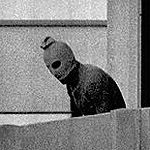
At 5:00 AM, September 5th, 1972, a seminal event in the development of modern terrorism took place. Eight Palestinian terrorists invaded the site of the Olympic Games in Munich, Germany. They killed and took hostage eleven Israeli athletes competing in the Games, demanding the release of over 200 imprisoned Arabs and 2 German terrorists. Over the next few tension-filled days, all the hostages and some of the terrorists were killed, and the remaining terrorists escaped, mostly due to incompetence and perfidy of the German government. The Olympic Committee made a controversial decision to continue the Games, and has never held any memorial for the slain athletes. Eventually almost all of the remaining terrorists were hunted down and killed by Israeli agents, directed by then Prime Minister Golda Meir.
-- Munich Remembered, by Judith @ Kesher Talk.
The authoritative documentary of the Munich Massacre is One Day in September.
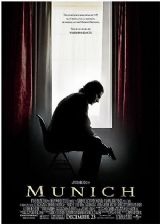
The new Steven Spielberg film Munich, loosely based on George Jonas' book Vengeance, purports to be "the story of what happens next," following the 1972 Munich Massacre. Many critics and pundits (predominantly those on the left) have praised it as a stirring commentary on the Israeli-Palestinian conflict and its "cycle of violence", as well as a cinematic protest against the Bush administration's "war on terrorism."
Munich: Praise
Discussing The Morality of 'Munich' Alternet Dec. 24, 2005), Jordan Elgrably heralds Munich as "the work of a mature filmmaker--one who does not appear beholden to popular American Jewish opinion that Israel is always the underdog," with a timely moral lesson for today's conflict:
The military occupation of Palestinian territories is in its 38th year; the settlement movement continues apace; and all the international peace initiatives have failed. The one dependable reality of the conflict -- Palestinian suicide bombings and Israeli targeted assassinations -- is utterly bankrupt. Nothing remains but for the Palestinians to seek justice with a nonviolent revolution for peace, in the spirit of Mahatma Gandhi, and for the Israeli people to follow new leaders who can devise political rather than military solutions.
Andrew Gumbel applauds Munich's implicit criticism of President Bush: (The Independent January 5, 2006):
The material not only takes a sideswipe at Israel and its long-standing policy of doing whatever it takes to guarantee its own survival. The parallels with George Bush's America are also unmistakable, at a time when the moral standing of the United States around the world has been severely undermined by reports of torture, targeted killings and war justified by intelligence that was either incorrect or deliberately skewed to suit a pre-determined political agenda. To ensure that the point is not missed, the film concludes with a shot of the lower Manhattan skyline including the now-fallen twin towers of the World Trade Center.David DiCerto of the USCCB's (Conference of Catholic Bishops) Office for Film & Broadcasting praises Munich as "a clear statement by the filmmaker that violence comes at a cost of one's soul," a continuation of "a cinematic conversation about the value of human life begun with Schindler's List. The message of that film was that 'whoever saves one life, saves the world entire.' The grim counterpoint here suggests that in taking lives the light of our humanity is collectively dimmed."
And JB (aka Dawnwatchman explicates Munich's gospel of nonviolence:
Munich speaks extensively about home, brotherhood, morals, and achieving peace on earth. However, these themes are secondary to the point Spielberg is trying to make through a powerful meditation. The dogma of an eye for an eye does not work. Here is where the irony comes into play, for the solution is most likely beyond what Spielberg intended. For we know that only the New Law is capable of justifying a man in the sight of God. Therefore, the problems and conflicts in the Middle East can’t be arbitrated using a precept of the Old Law. The New Law alone is sufficient. What this means is something which neither side is willing to accept. Israelis and Palestinians need to learn to live together. To break bread together, so to speak. It’s either that or somebody has to relocate to another part of the world, either of this life or the next. In better words, the Old Law must pass away:“You have heard that it hath been said: An eye for an eye, and a tooth for a tooth. But I say to you not to resist evil: but if one strike thee on thy right cheek, turn to him also the other.” – Matt., 5:38-39
Munich: Criticism
On the other hand, other critics have charged that the very zealousness with which Spielberg condemns the Israeli-Palestinian conflict has led him to entertain the notion of "moral equivalence" -- namely, that there is, with a view to the consequences, no ultimate difference between the Palestinian terrorist and the Israeli soldier.
Captain's Quaters, for instance, gave a disappointing review of the film:
On its most facile level, Munich is a gripping film. Had it been based on complete fiction -- if Spielberg had had the sense to manufacture a hypothetical instead of hijacking history and twisting it -- then it might have even had a valid point to make. Spielberg has lost nothing as a film director in a technical sense, . . . The cinematography, music, mood, and all of the technical efforts put into the film are first rate, without a doubt.The problem with Munich, says the author, is that "by equating the two sides, Spielberg and the world gave the perpetrators of terrorism the same moral standing as its victims, especially when the victims sought to ensure that their enemies could not live long enough to plan more such attacks."And every last bit of it gets wasted by a silly sense of moral equivalency that comes from a fundamental misrepresentation of the threat Israel faces, and in the strongly suggested allegorical sense, the threat that faces the US and the West now.
Cliff Kincaid and Roger Aronoff of Accuracy in the Media describe the film in terms of a Hollywood Surrender to Terrorists:
It is apparent that the movie is not only supposed to be historical but meant to send a message to Israel, the U.S. and the Bush Administration. The film's website even says that "the film takes audiences into a hidden moment in history that resonates with many of the same emotions in our lives today." Spielberg intends to convince us that responding to terrorism with military force is hopeless. . . .FrontPageMag also hosted a (sometimes heated) Symposium on Munich, inviting several authors and commentators -- pro and con -- to discuss the meaning of the film. Carl Horowitz points out that Munich mastermind Mohammed Daoud has voiced his disagreement with the film's depiction of his team, charging: "We did not target Israeli civilians. Some of the athletes had taken part in wars and killed many Palestinians. Whether a pianist or an athlete, any Israeli is a soldier." According to Horowitz, Doud's "factually-challenged rant performs a useful function. For it indicates that Spielberg would have had to have gone a lot further to appease his Arab critics – that is, to make a film that truly was morally equivalent."The real problem with the film is the moral equivalence, as Spielberg talks about "intransigence" and complains about "response to a response," as if Israel is at fault for trying to defend itself. What he seems to forget is that Israel is fighting for its very existence against an Arab/Muslim bloc of nations that still preaches hatred and destruction of Jews and Israelis.
Roger Ebert, who gave the film a big thumbs up, says about Spielberg's approach: "By not taking sides, he has taken both sides." But how can that be morally correct or defensible?
Arnold Steinberg disagrees:
This movie is an assault on the war on terrorism. That's why the movie ends with the twin towers in the background. It's supposed to bring you full circle, on the cycle of violence b.s. which is the corollary of moral equivalence, alongside the Arabist belief that the U.S. provoked 9-11.This movie clearly implies the Israeli response to Munich escalated, if not unleashed, a new generation of terrorism that culminated in 9-11. Kushner cleverly projected plausible even-handedness, but on the points that mattered, he gutted Israel. Remember, the Palestinian wins the homeland debate by default. I talk mainly about Kushner, because he used Spielberg, who has much more clout. . . . Munich was dishonest, overwhelmingly so, factually. Moreover, the mission, to the extent it existed, was not revenge, but to disrupt the terrorist hierarchy, which it did. And to quote Daoud attacking Spielberg? Bottom line -- this movie depicts the straight Arabist line -- this is a real estate conflict and ignores the reality that key Arab constituencies, from religious zealous to secular extremists, hate Jews and want them dead.
In Spielberg’s Moral Confusion (NRO, Jan. 6, 2006), Monica Charen criticizes Spielberg's inattention to history and the impact it will likely have on its audience, some of whom weren't even alive in 1972 (like myself, I admit) and probably won't bother investigating the actual facts of the incident:
Munich is a well-crafted movie, but it is a deeply and disturbingly dishonest one. Many moviegoers were not even born in 1972, and many who were alive will scarcely remember the details. Do moviemakers owe nothing to them? Do they owe nothing to the truth? This is not Oliver Stone’s JFK, but for that reason its effect may be more insidious. The film looks like history but it is a morality play of the artist’s imagination. Spielberg uses real historical figures like Golda Meir as props, putting words in their mouths that they not only did not say, but would never have said. During the opening credits, the audience is informed that the film is “inspired by real events.” That could mean anything — but movie audiences probably will not parse the words with lawyerly care. They will read it in the context of a film that offers generous servings of verisimilitude. There are clips of sportscaster Jim McKay reporting from the Munich Olympics in 1972, as well as the voice of Peter Jennings narrating the harrowing events. Some of the details of the kidnapping and murder of the eleven Israeli athletes are well-researched. But as CC Colton warned, “Falsehood is never so successful as when she baits her hook with truth.”
Credible Witness? -- Rinker Buck, George Jonas and Yuval Aviv
 To compound the problem, Monica Charen notes that the very book Tony Kushner allegedly based his script on -- George Jonas' Vengeance: The True Story of an Israeli Counter-Terrorist Team -- is itself highly questionable:
Jonas based his tale on the word of one Israeli who claimed to have headed a clandestine assassination squad for the Mossad. But Jonas was the second, not the first author to whom this particular Israeli had peddled this tale of “Avner,” the Israeli hit man. The first, according to Time, was a writer named Rinker Buck who was offered an advance from Simon and Schuster. But the deal fizzled when Buck traveled to Europe to check his informant’s information and found that “he was changing his story daily.” Buck said he could not write the book in good conscience. Jonas apparently could. And while the book has been debunked for 20 years, Spielberg saw fit to build a movie upon it.
- For background on Rinker Buck's conscientious refusal to peddle Avner's story, see "Believing What You Read", by Thomas Griffith Time June 25, 1984).
- More on Jonas' book from Bret Stevens (Munich: What's wrong with Steven Spielberg's new movie Wall Street Journal Jan. 1, 2006): "Yuval Aviv, who claimed to be the model for Avner . . . was, according to Israeli sources, never in the Mossad and had no experience in intelligence beyond working as a screener for El Al, the Israeli airline."
- For background on Yuval Aviv himself, see Spielberg could be on the wrong track, by Yosi Mellman Ha'aretz Jan. 8, 2006:
The problem arose five years later, in 1989, when a third party claimed in a lawsuit that private investigator Yuval Aviv, an Israeli, was Canadian journalist George Jonas' source. In the lawsuit, Jonas identified Aviv as a key figure in the book and argued that Aviv had dishonored an agreement and prevented him from receiving royalties due to him from the profits of the film.
After this identification, the international press began to publish articles about Aviv. Investigative reports about him revealed that he represented himself as a Mossad agent even though he had never worked in the Mossad and certainly had not participated in operations to kill those involved in the athletes' murder. Aviv, as he emerged from these investigative reports, had a special fondness for conspiracy theories, and it turned out that he was willing to hire out his services to anyone who was willing to pay, even to both sides of the same dispute.
Vengeance author George Jonas himself makes his case for telling "Avner's" story (and the eventual Hollywood cinematization/bastardization) in "the Spielberg massacre" (Macleans Jan. 7, 2006). Jonas stands by his man ("though he was not without a capacity for invention . . . "Avner" described a string of operations of which he had first-hand knowledge") and disavows any relationship with Aviv ("The Israeli newspaper Ha'aretz floats the canard that my source was revealed to be one "Yuval Aviv" in the late 1980s when I sued him in a contract dispute in New York. The fact is, I've never sued anyone in my life, in New York or anyplace else").
At the same time, Jonas notes with clear disapproval Kushner's involvement with the Munich screenplay:
The confirmation that production will definitely be put over until 2005, pending a new script to be written by Tony Kushner, comes only in September. It doesn't come from Mendel. It comes from "Avner" who appears to be very much in the loop -- and thoroughly besotted. A spook in the grip of celebrity worship is a sight to behold.and expresses his disappointment with the finished project by the 'King of Hollywood' himself:"Avner" writes that with the new script Spielberg is planning "in some aspects to stay parallel with the book. But of course he [takes] the book where only Steven can take it." Considering Kushner's stance on Israel, it isn't hard to imagine where that will be. In addition to his magnum opus, Angels in America: A Gay Fantasia on National Themes, Spielberg's new screenwriter is co-author (with Alisa Solomon) of a 2003 book, Wrestling With Zion: Progressive Jewish-American Responses to the Israeli-Palestinian Conflict. The title forecasts a film that will be a "progressive" Jewish-American response to the Munich massacre. No wonder there's a reluctance to let me see the script.
Spielberg's "Munich" follows the letter of my book closely enough. The spirit is almost the opposite. Vengeance holds there is a difference between terrorism and counterterrorism; "Munich" suggests there isn't. The book has no trouble telling an act of war from a war crime; the film finds it difficult. Spielberg's movie worries about the moral trap of resisting terror; my book worries about the moral trap of not resisting it.
 Disputing Jonas' account of the operation is Time magazine Israeli correspondent Aaron Klein's newly-published Striking Back: The 1972 Munich Olympics Massacre and Israel's Deadly Response:
A main disagreement between the two books is whether the Mossad's assassinations of the Black September leaders that followed the 1972 Olympic attacks was an emotional reaction against the attackers, as "Vengeance" and "Munich" both assert, or whether, as Klein argues, it was also a strategic response to break up a terrorist network.("Rival Tome Snipes at Munich Variety Award Central, Dec. 12, 2005)."Striking Back" was actually in the works at Random House several years ago, before Spielberg revealed he was working on the film, and wasn't set to come out until next year. Random House rushed publication when it learned of the film's release.
Setting the Record Straight
 The Jewish blog KesherTalk provides a good roundup of pundit reactions, reviews and blogger commentary on Munich.
Likewise, they do the world a favor by drawing our attention to the historical account of Munich -- the massacre, with a series of reflections on the senseless slaughter of the Israeli athletes:
- The Protagonists Speak
- The PLO, The Germans, and the French
- The Athletes
- The Olympics
- The British Arabists
- First They Came . . .
Parting Thoughts
As one who appreciates Steven Spielberg's previous films (Schindler's List and Saving Private Ryan especially) and his undeniable prowess in moviemaking, I'd certainly like to believe him when he repudiates "blind pacifism," proclaims his fidelity to Israel and defends the making of the film as an exercise in Talmudic questioning (A telephone call with Spielberg, by Roger Ebert. Dec. 25, 2005).
At the same time, having seen the movie myself, I've come to some judgements of my own about the film:
"Humanizing" Terrorism and drawing "Moral Equivalence"
Yes, a certain degree of "humanizing" of the terrorists does occur in the film -- the selected targets are shown in a positive light: a poet reading his translation of 'Arabian Nights' in Italian to a sidewalk audience; a good father with his loving wife and adoring daughter; a good-natured gentleman who offers a cigarette and sleeping pills to Avner before he goes off to bed (and to his death). In reminding us of their humanity, their crimes are practically hidden, their complicity in the deaths of innocents obscured by the veneer of gentleness and charm.
Yet, even in a stairwell encounter between Avner and a Palestinian named Ali, in which the latter is given the opportunity to present his grievances against Israel, I did not feel that Spielberg was putting forth "moral equivalence" in the sense that the direct actions of the terrorists and those of the Israeli strike team were of a piece. Whereas the Palestinians are shown mercilessly slaughtering the Olympic athletes, Avner and his men take scrupulous care not to harm innocent civilians, nearly-aborting one mission where the target's daughter was endangered. Some critics berated Avner's questioning and moral deliberation as a sign of weakness; I'm inclined to agree with Sonny Bunch (Munich Syndrom Weekly Standard Jan. 6, 2006):
. . . Compare this to the Palestinian terrorists who have no problem with turning AK-47s on hogtied hostages. And then there is the deeper question of humanity: Avner understand the justness of his mission, but still struggles with the taking of life. The terrorists show no such qualms.And yet, I must say there was a great deal in the movie that could -- and did -- lead audiences to conclude a "moral equivalence" with respect to ends: in suggesting that the Israeli's counter-terrorism tactics were themselves a propogator of more terror, and that resorting to armed force for whatever reason inevitably perpetuates a "cycle of violence."
James Bowman, resident scholar at the Ethics and Public Policy Center, lists "a few of the conventional ideas served up by [Spielberg and Kushner]" (Munich: A Review The American Spectator Dec. 30, 2005):
* Revenge is an uncivilized, savage act that lowers the revenger to the level of his victim. As a result, there is always a certain moral equivalence between killer and victim.Despite Spielberg's intentions, it seems to me that Munich renders itself easily exploitable by those who are anti-Israel, anti-Bush and anti-war, resisting the very idea that armed force can be used in a morally legitimate manner, in service to the good.* Engaging in revenge perpetuates a cycle of violence.
* Those who are caught up in this cycle and who kill in cold blood often suffer terrible agonies of conscience: nightmares, paranoia, substance abuse, and other manifestations of what we have learned to call post-traumatic stress disorder.
* From governments of all kinds, corruption, violence, and lack of human compassion is to be expected.
* Therefore, one should put loyalty to one's family and friends ahead of loyalty to one's country.
In his reflections on the film -- Art Needs Moral Vision (VictorHansen.com Dec. 27, 2005) -- Bruce Thornton describes the phrase "cycle of violence" as indicative of a modern moral pathology: the inclination to see force "not in moral terms — that is, as the instrument of a righteous or unrighteous choice and aim — but as a reflexive reaction to grievances and wounds to self-esteem." According to Thorton, it is a pathology that has been soundly exploited by Arab terrorists in the defense of their cause:
Jews traumatized by anti-Semitism and the Holocaust drove from their homes Arabs who, in turn traumatized by their suffering and the thwarting of their “nationalist aspirations,” turn to violence, which provokes a response from the Israelis, which creates more suffering, which provokes more violence, and on and on. All we need to do is break the cycle — which usually means getting Israel to stop reacting to Palestinian violence — create a Palestinian state, and the lion will lie down with the lamb.Thorton himself sees this as the underlying viewpoint of Spielberg's Munich:
In Munich . . . force is viewed with the suspicion typical of the quasi-pacifist liberal. Using force against murderers is futile, the movie keeps telling us, for each dead terrorist is replaced by another one, each killing of a terrorist inspires another act of terrorist retribution. I wonder what would have happened if the same attitude had been taken regarding Nazis or kamikaze pilots. Thank goodness our fathers and grandfathers had more sense. They knew that evil men have to be destroyed, and you stick with the job until the evil men give up or are no more. They knew that evil men choose their evil to advance some aim, and will try to kill you no matter what you do, and are more likely to take heart from a failure to resist than to reconsider their evil aims or to abandon violence. They knew that the sorts of reservations Munich indulges are not signs of a sophisticated sensibility but rather the evasions borne of moral uncertainty, Hamlet-like doubts whose purpose is to avoid action and moral responsibility.The moral evasions at the heart of Munich evoke another Munich, the Munich of Neville Chamberlain and appeasement, that moment in 1938 when moral exhaustion confronted evil and blinked, unleashing a force of destruction that cost 50 million dead and that was stopped not by understanding of context or empathy with the enemy’s humanity but by righteous force wielded by men who weren’t afraid to call evil by its proper name.
Munich and the Greater Question of 'Justified Use of Armed Force
 I am presently reading The War to Oust Saddam Hussein: The Context, The Debate, The War and the Future (Rowman & Littlefield, 2005), by James Turner Johnson, a notable scholar of military ethics and the just war tradition. Professor Johnson is severely critical of Bishop Wilton Gregory's stance during the Iraq war (and the subsequent position of the USCCB), because its argument against the war began with the prejudice that, in the words of Bishop Gregory, "a moral presumption against the use of armed force." According to Johnson, such reasoning is at a marked variance with the classical just war tradition:
Just war thinking in its classic form is based on something quite different -- a conception of life in political community oriented to a just and peaceful order, in which the use of armed force is a necessary tool to be used by responsibile political authority to protect that just and peaceful order in a world in which serious threats are not only possible but actual. In the presumption against war model, force itself is the moral problem, and peace is defined as the absence of the use of such force. In the just war model rightly understood, injustice and the threat of injustice are the fundamental moral problems, for in the absence of justice, the political community is not rightly ordered, and there is no real peace either in that community or in its relation to other political communities. Force here is not evil in itself; it takes its moral character from who uses it, from the reasons that are used to justify it, and from the intention with which it is used. These are, of course, the classic just war requirements of sovereign authority, just cause, and right intention, and they correspond directly to right order, justice, and peace, the goods at which political community should aim as defined in the Augustinian conception of politics within which just war tradition is soundly rooted. To be sure, force is evil when it is employed to attack the justice and peace of a political order oriented toward these goods, but it is precisely to defend against such evil that the use of force may be good. Just war tradition had to do with defining the possible good use of force, not finding exceptional cases when it is possible to use something inherently evil (force) for the purposes of good.This post is long enough, so in the interest of time I will refer the reader to James Turner Johnson's excellent essay Just War, As It Was and Is (First Things 149 (January 2005): 14-24); George Weigel also touches upon this briefly in Force of law, law of force (The Catholic Difference April 30, 2003), and at length in his study Tranquillitas Ordinis: The Present Failure and Future Promise of American Catholic Thought on War and Peace Oxford UP, 1987.
I can't help but notice some affinities between those who praise Munich as a cinematic protest against violence (the use of force per se) and those who advocate "a moral presumption against the use of armed force" as the starting point for deliberation in matters of war. I think that a film like Munich might compel Catholics and Christians to evaluate where they stand with respect to this issue:
Is the only response to terrorism the eschewing of violence, the adoption of absolute pacifism?
Is there such a thing as a justifiable and legitimate use of armed force?
Is the 'just war tradition' as it has been developed in Catholic tradition rendered absolete, the opinion put forth by a few voices within the Vatican Curia?
With respect to the last question, I am well aware that then-Cardinal Ratzinger, in a May 2, 2003 interview with Zenit, expressed the opinion that "given the new weapons that make possible destructions that go beyond the combatant groups, today we should be asking ourselves if it is still licit to admit the very existence of a 'just war.'" Some have (incorrectly, I think) imbued this specific line with the full weight of magisterial authority, while others -- like James Turner Johnson -- have questioned its implications, as well as its reasoning.
Likewise, the question is also raised: in responding to terrorism, what is the appropriate, reasonable and morally justifiable course of action?
Are "targeted assassinations" in the prevention of terrorism acceptable? The Logic of Israel's Targeted Killing, by Gal Luft (Middle East Quarterly Volume X, No. 1, Winter 2003) describes the procedure:
Israelis dislike the term "assassination policy." They would rather use another term—"extrajudicial punishment," "selective targeting," or "long-range hot pursuit"—to describe the pillar of their counterterrorism doctrine. But semantics do not change the fact that since the 1970s, dozens of terrorists have been assassinated by Israel's security forces, and in the two years of the Aqsa intifada, there have been at least eighty additional cases of Israel gunning down or blowing up Palestinian militants involved in the planning and execution of terror attacks.The legality of Israel's policy is presently being debated in Israeli courts. In a July 2001 State Dept. briefing, the Bush Administration stated that "Israel needs to understand that targeted killings of Palestinians don't end the violence, but are only inflaming an already volatile situation and making it much harder to restore calm." Yet, in a Fox News interview August 2, 2001, Vice President Cheney has also suggested that
"If you've got an organization that has plotted or is plotting some kind of suicide bomber attack, for example, and they have evidence of who it is and where they're located, I think there's some justification in their trying to protect themselves by preempting."The formal position of the U.S. Government is conveyed in Executive Order 12333, signed by President Ronald Reagan, directing that "no person employed by or acting on behalf of the United States Government shall engage in, or conspire to engage in, assassination." According to the Washington Post, "the original version was signed in 1976 by President Gerald R. Ford in the wake of public disclosure in 1975 that the CIA, with White House support, had attempted assassinations in the 1950s and 1960s of Cuban President Fidel Castro and leaders in the Congo and the Dominican Republic" (Source: Walter Pincus, Washington Post 1998).
However, one can't help but note the "selective targeting" of Al Qaeda members in counter-terrorist operations (the most recent being a Pakistani air-strike which killed two senior members of Al Qaeda and the son-in-law of its No. 2 leader, Ayman al-Zawahiri (New York Times Jan. 19, 2006). How does this differ from the present strategy of Israel?
At this time, Israel is faced with the threat of Iran, a nation that has barely concealed its active seeking nuclear arms, and whose president has stated that Israel should be "wiped off the map," and "God willing, with the force of God behind it, we shall soon experience a world without the United States and Zionism."