Monday, August 27, 2007

Poetic Justice

The ultimate betrayal? Son of Nazi Embraces Judaism (Jewish World Review August 21, 2007):
Bernd Wollschlaeger has two stories to tell.

First, he's a former officer in the Israel Defense Forces, a physician who developed expertise in biological warfare. He lives in Miramar, Florida, runs a family practice in North Miami Beach, has become a legislative leader of the American Medical Association and is active in local Jewish causes.

Now, at 49, he has decided to tell "my coming-out story."

It is this: He was born the Christian son of a World War II German tank commander — a third-generation warrior who received Deutschland's highest military honor, the Iron Cross, which was pinned on his uniform by Adolf Hitler himself. . . .

Good one. Here's another from last year: Matthias Göring Goes Kosher (Der Spiegel May 10, 2006):
Mr. Göring is determined to discover the origin of the wine we're drinking. The waiter, an old man with snow white hair and a dark blue kippa, toddles over and says: "It's from a small vineyard near Haifa, Sir." Göring leans back in his chair, satisfied. "Ah, Israeli wine," he sighs, "Perfect."

That's Matthias Göring, not Hermann. Even so, it is very odd to be having lunch in a Jewish restaurant with a direct descendent of Adolf Hitler's right-hand man. Matthias Göring, though, couldn't be happier here. After 44 years of "despising Jews" and suffering the curse of his family name, the 49-year-old physiotherapist has become a full-on Israel lover. He wears a kippa, keeps kosher, celebrates Shabbat, is learning Hebrew and is even considering converting. His family thinks he has gone mad.

"They think I've got a screw loose," grins the man who now works with the victims of suicide bombings. "But I know what has happened to me is completely and utterly real."

Monday, February 12, 2007

Israel-Vatican Relations & The Fundamental Agreement

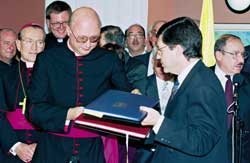
On December 30, 1993, the Fundamental Agreement was signed by Msgr. Claudio Celli, Vatican assistant secretary of state and Israel's deputy minister of foreign affairs, Yossi Beilin, paving the way to full diplomatic relations between the two parties in 1994:
The Fundamental Agreement extends the theological advances of Nostra Aetate into the political realm, creating for the first time formal diplomatic relations between the Holy See and the State of Israel. The Agreement signifi es a historic step in the evolution of the Roman Catholic Church’s attitude toward Judaism and the Jewish People.

The Fundamental Agreement addresses three spheres of relations: 1) political relations between Israel and the Holy See; 2) relations between the Jewish People and the Catholic Church; and 3) relations between the State of Israel and the Roman Catholic Church.

[Source: Milestones in Israel-Holy See Relations 1993-2005: Commemoration of the 40th Anniversary of Nostra Aetate Consulate General of Israel in New York].

In 1997 the "Legal Personality" Agreement between the State of Israel and the Holy See was signed:

[regularizing] the status and legal personality of the Roman Catholic Church and its institutions under Israeli law, after approximately 500 years of undefined legal status under Ottoman Empire, the British Mandate, and Israeli sovereignty.

This agreement marks the first de jure recognition of the Roman Catholic Church by any government in the Holy Land. It bestows upon the Roman Catholic Church the autonomy to run its internal affairs, subject to Israeli law in interaction with other bodies. The Legal Personality Agreement constitutes a continuation of the Fundamental Agreement of 1993.

In an exclusive article, The ten years of the Fundamental Agreement 30 Giorni ["30 Days"] No. 12, 2003, Israeli statesman Yossi Beilin describes the "behind the scenes" discussions which led to the signing:

These were open talks, launched at the Vatican’s initiative in the summer of 1991, even before the Madrid Conference. It was Archbishop Andrea Cordero Lanza di Montezemolo, the apostolic delegate in Jerusalem, who announced the Vatican’s intention to initiate negotiations on an agreement with Israel, and he did so in consultation with Dr. David Jaegar, an Israeli Jew who had become a Franciscan priest, with boasted special knowledge in Canon Law.

The initial probes between Israel and the Vatican revealed the main dispute between them: Israel wanted to reach, first of all, an agreement on diplomatic relations between the two states, and only subsequently to discuss questions such as the freedom of religion, Church taxation, education, etc. The Vatican wanted to deal with all the practical matters, and to remove – at least at the first stage – the matter of the diplomatic relations from the agenda. . . .

Each party came to the table with its own priorities -- for Israel, the objective was (understandably) "the common war on anti-Semitism and unequivocal recognition of the State of Israel." For the Church, the concern lay with the rights of Catholics residing in the State of Israel:

. . . the guarantee of freedom of worship for Catholics, the legal status of priests, and the special approach of Pope John Paul II, who, as early as 1981, had sent to the President of the State of Israel a blessing for the New Year, and in 1986, had visited the synagogue in Rome – symbolic acts which stressed – alongside a long list of other acts – his special deep respect for Israel and its people.
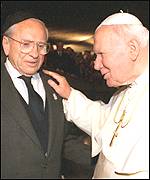
John Paul II's greetings to Israel in celebration of their new year appears to have sprung from a collaboration with his lifelong friend Jerzy Kluger, who played a subtle yet instrumental role (at the Pope's request) in facilitating communication between Israel and the Vatican (How a Pope's Boyhood Friend Helped Forge Ties to Israel):
When the Archbishop was named Pope in 1978, he stunned the world by granting his first papal audience, or formal reception, to Mr. Kluger and his family.

Three years later, the Pope was wounded in an assassination attempt. On Mr. Kluger's third visit to the Pope in the hospital, the Pope suggested that with the Camp David accords pointing the way for peace in the Middle East, it was time for the Vatican to consider opening diplomatic channels to Israel.

"Are you willing to help?" Mr. Kluger says the Pope asked him. "We must proceed cautiously, officially and unofficially."

Mr. Kluger played the role of broker and host, inviting Israeli and Vatican representatives to dine at his tennis club in Rome and playing bridge with key Cardinals. The steps were often small and symbolic. Once he relayed an Israeli diplomat's suggestion that the Pope send a telegram with Jewish New Year greetings to the President of Israel. The Pope sent the telegram.

In 1994, at the ceremony welcoming the first Israeli Ambassador to the Holy See, Mr. Kluger stood for photographs next to the Pope, sandwiched between Israeli and Vatican dignitaries.

"I was a friend," Mr. Kluger said. "And we had friendly conversations, and friendly relationships which one way or another helped these developments. That's all."

(Pope John Paul II and Jerzy Kluger's friendship was made the subject of Darcy O'Brien's The Hidden Pope: The Untold Story of a Lifelong Friendship (Roedale Books, 1998).

Related Commentary on The Fundamental Agreement

  • In Israel-Vatican Relations Since the Signing of the Fundamental Agreement, Rabbi David Rosen discusses some of the conceptual conceptual hurdles that were tackled in the process of formalizing the Fundamental Agreement and Israeli-Catholic relations since its signing in 1993. [Microsoft Word - printable format]:
    . . . as the Preamble of the Agreement indicates, the accord took place within the wider context of Catholic-Jewish reconciliation on which it undoubtedly had a profoundly positive impact in turn. Indeed, for many Jews especially in Israel, the diplomatic normalization served as testimony and proof of the genuineness of the transformation in theological attitudes and teaching that had taken place over the previous thirty years. The third relationship addressed by the majority of the articles in the Fundamental Agreement, concerns the relationship between the Catholic Church in Israel and the State.

    While Israel's goal was essentially the first of these3, the Holy See's primary interest concerned the third. Indeed this difference reflects the divergent perceptions of the principle purpose of the bilateral relations.

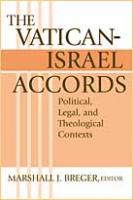
    Rosen's article was published in the anthology The Vatican-Israel Accords: Political, Legal, and Theological Contexts, edited by Marshall J. Breger. University of Notre Dame Press (February 2004).

  • Israel's Relations with the Vatican by Aharon Lopez (former Israeli ambassador to Vatican). No. 401 13 Adar 5759 / 1 March 1999. Jerusalem Center for Public Affairs:
    The establishment of diplomatic relations between Israel and the Holy See is not to be considered as a point of arrival, but rather as a starting point. We are climbing up a mountain together and, from time to time, we reach important and substantial milestones towards the mountain's peak.

    In closing, let me share with you a very significant event which I cherish close to my heart. At the beginning of my mission as Ambassador to the Holy See, I received a fax from an Israeli Christian Arab who requested my help in asking the Pope to baptize his son. He and his wife were especially keen in seeing their wish fulfilled because, sadly, they had experienced the tragic loss of their first son.

    Knowing that there are "only" 989 million Catholics all over the world, I feared we might have some difficulties in fulfilling such a request. Nevertheless, I contacted the proper authorities in the Vatican and emphasized that during the presentation of my credentials I had assured the Pope that I am representing all Israeli citizens--Moslems, Christians, and Jews alike--and therefore it was my duty to submit this request on behalf of a Christian citizen of Israel.

    I was very pleased, a few weeks later, to receive a positive answer. Indeed, the Pope agreed to conduct the ceremony in his private chapel. I will never forget the smile on the face of the boy's parents after their dream came true.

The Vatican-Israel Accords: Political, Legal, and Theological Contexts, edited by Marshall J. Breger. University of Notre Dame Press (February 2004). [Contents].

Published during the tenth anniversary year of The Fundamental Agreement, The Vatican-Israel Accords brings together essays that analyze the legal, historical, theological, and political meaning of the Accords.

The compelling essays in this collection explore not only the document and events surrounding its signing, but also the past, present, and future of Catholic-Jewish relations. Contributors, who include scholars from Israel, Italy, France, Spain, and the United States, contend that the history and structure of the Accords offer lessons that may be instructive for others involved in seeking peaceful resolutions to conflict, particularly those who work for peace between Palestine and Israel.

Contributors: Marshall J. Breger, Laurenzo Cremonesi, Msgr. Richard Mathes, David-Maria A. Jaeger, O.F.M., Leonard Hammer, Silvio Ferrari, Rafael Palomino, Msgr. Roland Minnerath, Rabbi David Rosen, Moshe Hirsch, Geoffrey Watson, Giorgio Filibeck, Ruth Lapidoth, Fr. Drew Christiansen, S.J., and Rabbi Jack Bemporad.

MARSHALL J. BREGER is professor of law at the Columbus School of Law, Catholic University of America.

Reviews "The Vatican-Israel Accords promises to make a tremendous contribution to understanding a tangled relationship. It is a unique, and uniquely valuable, volume." --George Weigel, Ethics and Public Policy Center, Washington, D.C.

Israeli-Catholic relations since the 1993 signing have not always gone smoothly. Sandro Magister reported on two impediments to Israeli-Vatican relations and the subsequent implementation of the Vatican-Israel accords (with regards to financial issues and the status of Church property) in 2005:

The first skirmish came on July 12. That day, John Paul II was commemorated in the Israeli parliament, the Knesset. And on that occasion, apostolic nuncio Pietro Sambi delivered a speech that was reprinted in its entirety by "L'Osservatore Romano" six days later.

In the speech, Sambi complained about Israel's failure to take practical measures to implement the accords with the Holy See reached in 1993 and 1994:

"The Fundamental Agreement, which was ratified by the state of Israel on February 20, 1994, and is recognized internationally, has not yet been incorporated into Israeli law by the Knesset. The same must be said of the Legal Personality Agreement ratified by Israel on December 16, 1998, and recognized internationally on February 3, 1999. The so-called 'Economic Agreement', prescribed by article 10 of the Fundamental Agreement, has not yet been concluded."

A meeting between the two parties to discuss the application of these agreements had been planned for July 26. But the meeting never took place, to the great disappointment of the Holy See and the Catholic community in the Holy Land.

On the day the ceremony was taking place in the Knesset, on July 12, Islamic terrorists carried out a serious attack in Netanya.

But at the Sunday Angelus on July 24, Benedict XVI did not mention Israel as being among the countries recently struck by terrorist attacks: Egypt, Turkey, Iraq, Great Britain.

Exploiting this omission, the next day the Israeli foreign minister summoned the Vatican nuncio, Pietro Sambi, to communicate a note of protest [...]

For further analysis on Pope Benedict's 2005 omission of Israel from a list of recent victims of terrorism, I refer to John Allen Jr.'s "Context crucial in Vatican-Israel uproar" (National Catholic Reporter, August 12, 2005).

After some tit-for-tat jousting between diplomats, Israeli Prime Minister Ariel Sharon moved to resolve any ill-feelings with the Vatican in a personal letter ("Israel, Vatican mend fences after dispute over pope's terrorism comments", by Arial David. World Wide Religious News August 27, 2005):

In his letter, Sharon said Benedict's efforts to promote dialogue with Jews and Israel made him "a true friend of Israel, genuinely committed to advancing tolerance, understanding and reconciliation," Ben Hur said in a phone interview, reading from the letter. He said Sharon then explained the reasons for his country's reaction to the omission.

"Israel has been devastated and victimized by terrorism, and we are very sensitive to any attempt to distinguish between Islamic terrorism which systematically targets innocent Israeli civilians and that which is aimed at citizens of other countries," Sharon wrote.

Sodano expressed his satisfaction with the letter during Tuesday's meeting, saying both sides had made mistakes and that he was happy to put the issue behind him, Ben Hur said. The letter also invited Sodano to visit Israel.

In August 2006, Magister also featured an interview with Israeli ambassador Oded Ben Hur, in which he commmented further on Israel's perception of Pope Benedict and Israel's expectations of Rome:

In mid-July, just when the war had broken out in Lebanon, [Oded] was deeply troubled by the first statements from the Vatican authorities: “All of them went the same way, against Israel. The true aggressor, Hezbollah, wasn’t even mentioned by name. But after this the judgments became more balanced.”

Q: Did this happen when Benedict XVI began speaking out personally?

A: I would go so far as to say that Benedict XVI looks at Israel from a different point of view, compared to others. He sees the state of Israel not as an error of history, but as the heart of the Jewish world, a heart that by right should beat in Jerusalem. At the same time he is a realistic pope, who understands that the Church’s political influence is limited. He knows that the Church’s strength is not political, but moral. And it is there that he exerts himself most. It’s the pope as the great educator of the world, reawakening consciences, illuminating the darkness of ignorance, and pointing out where evil is triumphing over the good.

Q: The Middle East is one of the places where evil abounds the most.

A: And it may be that today the international community is taking greater notice of this. What happened in Lebanon was not the rupture of a situation of peace. Peace wasn’t there before this war. In that country there was a cancer named Hezbollah, a state within the state, which held the civil population hostage and fought a war while using this population as a shield. Even today, after the ceasefire, Hezbollah says it does not at all consider the war to be over, and is refusing to disarm. And Hamas continues to launch Kassam rockets against Israeli cities. [...]

Q: What is expected from the Church of Rome?

A: A great deal. In Lebanon there is a strong Christian community that can act as a bridge for peace. The pilgrims to the holy places, when they come in great numbers, are also helpful to the local populations. I also have an idea that I have already proposed to the Vatican authorities: that of creating a task force with representatives from the three religions – Christianity, Judaism, and Islam – who would travel throughout the various countries of the Middle East spreading a message of reconciliation, in order to sensitize and mobilize those who sincerely desire peace, and separate them from extremist and violent groups.

In December of 2006 Israeli Prime Minister Ehud Olmert met with Pope Benedict XVI (Catholic News Service Dec. 14, 2006) - among the topics of discussion was the "dwindling Catholic population in the Holy Land, including in Bethlehem," and peace in the Middle East:

Ben-Hur said Pope Benedict thanked the prime minister for Israeli's declaration of a cease-fire with Palestinian militias, although Ben-Hur said the prime minister said it is getting more and more difficult "to withhold reactions" to missiles being launched into Israel from Gaza.

Ben-Hur said that when Olmert renewed a government invitation for the pope to visit Israel, the pope said he really wanted to make such a trip, but was looking for "a moment of calm."

"The prime minister told him, 'You can bring the calm,'" the ambassador said.

Talks between Israel and the Vatican resumed in 2007 with the goal of applying the provisions of the Fundamental Agreement's over the holy places, the Church‘s properties, and finances. In Holy See-Israel: painstaking resumption of negotiations (AsiaNews.it Bernardo Cervellera, December 12, 2006), Oded Ben Hur gave another interview on the nature of the impediments to negotations.

Related Resources

Updates

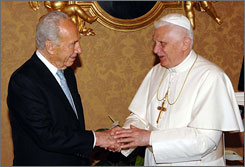
  • On September 9, 2007, Shimon Peres, in his first foreign visit as president of Israel, met with Pope Benedict at Castel Gandolfo and members of the Vatican curia, to discuss Catholic-Israeli relations and the situation in the Middle East. AsiaNews.it reports:
    Rome (AsiaNews) – The Israeli President Shimon Peres is “quite optimistic” regarding negotiations between Israel and the Holy See and has declared that “within the years end the most important problems will be resolved”. Answering a question put forward by AsiaNews, during a press conference, he also said that he had invited Benedict XVI to visit Israel. ...

    On the long standing question of the implementation of the Fundamental Agreement, 13 years on from its signing, the Holy See statement urges “a rapid conclusion to the important ongoing negotiations and the beginning of a constant dialogue with Israeli Authorities and local Christian communities, in view of their participation in working for the common good”.

    September 3 last –after a long summer pause – and after years of deadlock, negotiations between the Holy See and Israel recommenced. They aim to lead to an agreement regarding issues of taxation and Church properties, which have been waiting implementation since ’93.

    The Vatican statement makes no reference whatsoever to a possible visit by Benedict XVI to Israel, even if the pope has already expressed a positive opinion in the past. Peres told journalists that he was “moved” by the pope’s reaction to his proposal and defined Benedict XVI as “great spiritual figure”, underlining that “the Spirit” incarnated in the religions can give an important impulse to peace and the elimination of violence, “assassins and killings”.

Saturday, July 1, 2006

Catholic educators, priests, donate blood in solidarity with Israel

A group of 30 Catholic educators, including priests, donated blood yesterday in Jerusalem's Magen David Adom center in a show of solidarity for the Jewish state under attack, reports the Anti-Defamation League (July 1, 2006):
Members of the group, representing schools in ten states across the U.S. and in Washington, D.C., decided to give blood after they heard the sound of Hezbollah rocket strikes while touring in the north of Israel and learned of the nation's blood shortage.

Thursday, January 26, 2006

Reflections on Steven Spielberg's Munich

At 5:00 AM, September 5th, 1972, a seminal event in the development of modern terrorism took place. Eight Palestinian terrorists invaded the site of the Olympic Games in Munich, Germany. They killed and took hostage eleven Israeli athletes competing in the Games, demanding the release of over 200 imprisoned Arabs and 2 German terrorists. Over the next few tension-filled days, all the hostages and some of the terrorists were killed, and the remaining terrorists escaped, mostly due to incompetence and perfidy of the German government. The Olympic Committee made a controversial decision to continue the Games, and has never held any memorial for the slain athletes. Eventually almost all of the remaining terrorists were hunted down and killed by Israeli agents, directed by then Prime Minister Golda Meir.

-- Munich Remembered, by Judith @ Kesher Talk.

The authoritative documentary of the Munich Massacre is One Day in September.

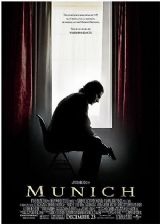
The new Steven Spielberg film Munich, loosely based on George Jonas' book Vengeance, purports to be "the story of what happens next," following the 1972 Munich Massacre. Many critics and pundits (predominantly those on the left) have praised it as a stirring commentary on the Israeli-Palestinian conflict and its "cycle of violence", as well as a cinematic protest against the Bush administration's "war on terrorism."

Munich: Praise

Discussing The Morality of 'Munich' Alternet Dec. 24, 2005), Jordan Elgrably heralds Munich as "the work of a mature filmmaker--one who does not appear beholden to popular American Jewish opinion that Israel is always the underdog," with a timely moral lesson for today's conflict:

The military occupation of Palestinian territories is in its 38th year; the settlement movement continues apace; and all the international peace initiatives have failed. The one dependable reality of the conflict -- Palestinian suicide bombings and Israeli targeted assassinations -- is utterly bankrupt. Nothing remains but for the Palestinians to seek justice with a nonviolent revolution for peace, in the spirit of Mahatma Gandhi, and for the Israeli people to follow new leaders who can devise political rather than military solutions.

Andrew Gumbel applauds Munich's implicit criticism of President Bush: (The Independent January 5, 2006):

The material not only takes a sideswipe at Israel and its long-standing policy of doing whatever it takes to guarantee its own survival. The parallels with George Bush's America are also unmistakable, at a time when the moral standing of the United States around the world has been severely undermined by reports of torture, targeted killings and war justified by intelligence that was either incorrect or deliberately skewed to suit a pre-determined political agenda. To ensure that the point is not missed, the film concludes with a shot of the lower Manhattan skyline including the now-fallen twin towers of the World Trade Center.
David DiCerto of the USCCB's (Conference of Catholic Bishops) Office for Film & Broadcasting praises Munich as "a clear statement by the filmmaker that violence comes at a cost of one's soul," a continuation of "a cinematic conversation about the value of human life begun with Schindler's List. The message of that film was that 'whoever saves one life, saves the world entire.' The grim counterpoint here suggests that in taking lives the light of our humanity is collectively dimmed."

And JB (aka Dawnwatchman explicates Munich's gospel of nonviolence:

Munich speaks extensively about home, brotherhood, morals, and achieving peace on earth. However, these themes are secondary to the point Spielberg is trying to make through a powerful meditation. The dogma of an eye for an eye does not work. Here is where the irony comes into play, for the solution is most likely beyond what Spielberg intended. For we know that only the New Law is capable of justifying a man in the sight of God. Therefore, the problems and conflicts in the Middle East can’t be arbitrated using a precept of the Old Law. The New Law alone is sufficient. What this means is something which neither side is willing to accept. Israelis and Palestinians need to learn to live together. To break bread together, so to speak. It’s either that or somebody has to relocate to another part of the world, either of this life or the next. In better words, the Old Law must pass away:

“You have heard that it hath been said: An eye for an eye, and a tooth for a tooth. But I say to you not to resist evil: but if one strike thee on thy right cheek, turn to him also the other.” – Matt., 5:38-39

Munich: Criticism

On the other hand, other critics have charged that the very zealousness with which Spielberg condemns the Israeli-Palestinian conflict has led him to entertain the notion of "moral equivalence" -- namely, that there is, with a view to the consequences, no ultimate difference between the Palestinian terrorist and the Israeli soldier.

Captain's Quaters, for instance, gave a disappointing review of the film:

On its most facile level, Munich is a gripping film. Had it been based on complete fiction -- if Spielberg had had the sense to manufacture a hypothetical instead of hijacking history and twisting it -- then it might have even had a valid point to make. Spielberg has lost nothing as a film director in a technical sense, . . . The cinematography, music, mood, and all of the technical efforts put into the film are first rate, without a doubt.

And every last bit of it gets wasted by a silly sense of moral equivalency that comes from a fundamental misrepresentation of the threat Israel faces, and in the strongly suggested allegorical sense, the threat that faces the US and the West now.

The problem with Munich, says the author, is that "by equating the two sides, Spielberg and the world gave the perpetrators of terrorism the same moral standing as its victims, especially when the victims sought to ensure that their enemies could not live long enough to plan more such attacks."

Cliff Kincaid and Roger Aronoff of Accuracy in the Media describe the film in terms of a Hollywood Surrender to Terrorists:

It is apparent that the movie is not only supposed to be historical but meant to send a message to Israel, the U.S. and the Bush Administration. The film's website even says that "the film takes audiences into a hidden moment in history that resonates with many of the same emotions in our lives today." Spielberg intends to convince us that responding to terrorism with military force is hopeless. . . .

The real problem with the film is the moral equivalence, as Spielberg talks about "intransigence" and complains about "response to a response," as if Israel is at fault for trying to defend itself. What he seems to forget is that Israel is fighting for its very existence against an Arab/Muslim bloc of nations that still preaches hatred and destruction of Jews and Israelis.

Roger Ebert, who gave the film a big thumbs up, says about Spielberg's approach: "By not taking sides, he has taken both sides." But how can that be morally correct or defensible?

FrontPageMag also hosted a (sometimes heated) Symposium on Munich, inviting several authors and commentators -- pro and con -- to discuss the meaning of the film. Carl Horowitz points out that Munich mastermind Mohammed Daoud has voiced his disagreement with the film's depiction of his team, charging: "We did not target Israeli civilians. Some of the athletes had taken part in wars and killed many Palestinians. Whether a pianist or an athlete, any Israeli is a soldier." According to Horowitz, Doud's "factually-challenged rant performs a useful function. For it indicates that Spielberg would have had to have gone a lot further to appease his Arab critics – that is, to make a film that truly was morally equivalent."

Arnold Steinberg disagrees:

This movie is an assault on the war on terrorism. That's why the movie ends with the twin towers in the background. It's supposed to bring you full circle, on the cycle of violence b.s. which is the corollary of moral equivalence, alongside the Arabist belief that the U.S. provoked 9-11.

This movie clearly implies the Israeli response to Munich escalated, if not unleashed, a new generation of terrorism that culminated in 9-11. Kushner cleverly projected plausible even-handedness, but on the points that mattered, he gutted Israel. Remember, the Palestinian wins the homeland debate by default. I talk mainly about Kushner, because he used Spielberg, who has much more clout. . . . Munich was dishonest, overwhelmingly so, factually. Moreover, the mission, to the extent it existed, was not revenge, but to disrupt the terrorist hierarchy, which it did. And to quote Daoud attacking Spielberg? Bottom line -- this movie depicts the straight Arabist line -- this is a real estate conflict and ignores the reality that key Arab constituencies, from religious zealous to secular extremists, hate Jews and want them dead.

In Spielberg’s Moral Confusion (NRO, Jan. 6, 2006), Monica Charen criticizes Spielberg's inattention to history and the impact it will likely have on its audience, some of whom weren't even alive in 1972 (like myself, I admit) and probably won't bother investigating the actual facts of the incident:

Munich is a well-crafted movie, but it is a deeply and disturbingly dishonest one. Many moviegoers were not even born in 1972, and many who were alive will scarcely remember the details. Do moviemakers owe nothing to them? Do they owe nothing to the truth? This is not Oliver Stone’s JFK, but for that reason its effect may be more insidious. The film looks like history but it is a morality play of the artist’s imagination. Spielberg uses real historical figures like Golda Meir as props, putting words in their mouths that they not only did not say, but would never have said. During the opening credits, the audience is informed that the film is “inspired by real events.” That could mean anything — but movie audiences probably will not parse the words with lawyerly care. They will read it in the context of a film that offers generous servings of verisimilitude. There are clips of sportscaster Jim McKay reporting from the Munich Olympics in 1972, as well as the voice of Peter Jennings narrating the harrowing events. Some of the details of the kidnapping and murder of the eleven Israeli athletes are well-researched. But as CC Colton warned, “Falsehood is never so successful as when she baits her hook with truth.”

Credible Witness? -- Rinker Buck, George Jonas and Yuval Aviv
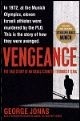
To compound the problem, Monica Charen notes that the very book Tony Kushner allegedly based his script on -- George Jonas' Vengeance: The True Story of an Israeli Counter-Terrorist Team -- is itself highly questionable:

Jonas based his tale on the word of one Israeli who claimed to have headed a clandestine assassination squad for the Mossad. But Jonas was the second, not the first author to whom this particular Israeli had peddled this tale of “Avner,” the Israeli hit man. The first, according to Time, was a writer named Rinker Buck who was offered an advance from Simon and Schuster. But the deal fizzled when Buck traveled to Europe to check his informant’s information and found that “he was changing his story daily.” Buck said he could not write the book in good conscience. Jonas apparently could. And while the book has been debunked for 20 years, Spielberg saw fit to build a movie upon it.
  • For background on Rinker Buck's conscientious refusal to peddle Avner's story, see "Believing What You Read", by Thomas Griffith Time June 25, 1984).

  • More on Jonas' book from Bret Stevens (Munich: What's wrong with Steven Spielberg's new movie Wall Street Journal Jan. 1, 2006): "Yuval Aviv, who claimed to be the model for Avner . . . was, according to Israeli sources, never in the Mossad and had no experience in intelligence beyond working as a screener for El Al, the Israeli airline."

  • For background on Yuval Aviv himself, see Spielberg could be on the wrong track, by Yosi Mellman Ha'aretz Jan. 8, 2006:
    The problem arose five years later, in 1989, when a third party claimed in a lawsuit that private investigator Yuval Aviv, an Israeli, was Canadian journalist George Jonas' source. In the lawsuit, Jonas identified Aviv as a key figure in the book and argued that Aviv had dishonored an agreement and prevented him from receiving royalties due to him from the profits of the film.

    After this identification, the international press began to publish articles about Aviv. Investigative reports about him revealed that he represented himself as a Mossad agent even though he had never worked in the Mossad and certainly had not participated in operations to kill those involved in the athletes' murder. Aviv, as he emerged from these investigative reports, had a special fondness for conspiracy theories, and it turned out that he was willing to hire out his services to anyone who was willing to pay, even to both sides of the same dispute.

Vengeance author George Jonas himself makes his case for telling "Avner's" story (and the eventual Hollywood cinematization/bastardization) in "the Spielberg massacre" (Macleans Jan. 7, 2006). Jonas stands by his man ("though he was not without a capacity for invention . . . "Avner" described a string of operations of which he had first-hand knowledge") and disavows any relationship with Aviv ("The Israeli newspaper Ha'aretz floats the canard that my source was revealed to be one "Yuval Aviv" in the late 1980s when I sued him in a contract dispute in New York. The fact is, I've never sued anyone in my life, in New York or anyplace else").

At the same time, Jonas notes with clear disapproval Kushner's involvement with the Munich screenplay:

The confirmation that production will definitely be put over until 2005, pending a new script to be written by Tony Kushner, comes only in September. It doesn't come from Mendel. It comes from "Avner" who appears to be very much in the loop -- and thoroughly besotted. A spook in the grip of celebrity worship is a sight to behold.

"Avner" writes that with the new script Spielberg is planning "in some aspects to stay parallel with the book. But of course he [takes] the book where only Steven can take it." Considering Kushner's stance on Israel, it isn't hard to imagine where that will be. In addition to his magnum opus, Angels in America: A Gay Fantasia on National Themes, Spielberg's new screenwriter is co-author (with Alisa Solomon) of a 2003 book, Wrestling With Zion: Progressive Jewish-American Responses to the Israeli-Palestinian Conflict. The title forecasts a film that will be a "progressive" Jewish-American response to the Munich massacre. No wonder there's a reluctance to let me see the script.

and expresses his disappointment with the finished project by the 'King of Hollywood' himself:
Spielberg's "Munich" follows the letter of my book closely enough. The spirit is almost the opposite. Vengeance holds there is a difference between terrorism and counterterrorism; "Munich" suggests there isn't. The book has no trouble telling an act of war from a war crime; the film finds it difficult. Spielberg's movie worries about the moral trap of resisting terror; my book worries about the moral trap of not resisting it.
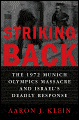
Disputing Jonas' account of the operation is Time magazine Israeli correspondent Aaron Klein's newly-published Striking Back: The 1972 Munich Olympics Massacre and Israel's Deadly Response:
A main disagreement between the two books is whether the Mossad's assassinations of the Black September leaders that followed the 1972 Olympic attacks was an emotional reaction against the attackers, as "Vengeance" and "Munich" both assert, or whether, as Klein argues, it was also a strategic response to break up a terrorist network.

"Striking Back" was actually in the works at Random House several years ago, before Spielberg revealed he was working on the film, and wasn't set to come out until next year. Random House rushed publication when it learned of the film's release.

("Rival Tome Snipes at Munich Variety Award Central, Dec. 12, 2005).

Setting the Record Straight
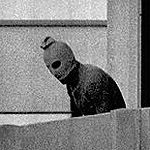
The Jewish blog KesherTalk provides a good roundup of pundit reactions, reviews and blogger commentary on Munich.

Likewise, they do the world a favor by drawing our attention to the historical account of Munich -- the massacre, with a series of reflections on the senseless slaughter of the Israeli athletes:

Parting Thoughts

As one who appreciates Steven Spielberg's previous films (Schindler's List and Saving Private Ryan especially) and his undeniable prowess in moviemaking, I'd certainly like to believe him when he repudiates "blind pacifism," proclaims his fidelity to Israel and defends the making of the film as an exercise in Talmudic questioning (A telephone call with Spielberg, by Roger Ebert. Dec. 25, 2005).

At the same time, having seen the movie myself, I've come to some judgements of my own about the film:

"Humanizing" Terrorism and drawing "Moral Equivalence"

Yes, a certain degree of "humanizing" of the terrorists does occur in the film -- the selected targets are shown in a positive light: a poet reading his translation of 'Arabian Nights' in Italian to a sidewalk audience; a good father with his loving wife and adoring daughter; a good-natured gentleman who offers a cigarette and sleeping pills to Avner before he goes off to bed (and to his death). In reminding us of their humanity, their crimes are practically hidden, their complicity in the deaths of innocents obscured by the veneer of gentleness and charm.

Yet, even in a stairwell encounter between Avner and a Palestinian named Ali, in which the latter is given the opportunity to present his grievances against Israel, I did not feel that Spielberg was putting forth "moral equivalence" in the sense that the direct actions of the terrorists and those of the Israeli strike team were of a piece. Whereas the Palestinians are shown mercilessly slaughtering the Olympic athletes, Avner and his men take scrupulous care not to harm innocent civilians, nearly-aborting one mission where the target's daughter was endangered. Some critics berated Avner's questioning and moral deliberation as a sign of weakness; I'm inclined to agree with Sonny Bunch (Munich Syndrom Weekly Standard Jan. 6, 2006):

. . . Compare this to the Palestinian terrorists who have no problem with turning AK-47s on hogtied hostages. And then there is the deeper question of humanity: Avner understand the justness of his mission, but still struggles with the taking of life. The terrorists show no such qualms.
And yet, I must say there was a great deal in the movie that could -- and did -- lead audiences to conclude a "moral equivalence" with respect to ends: in suggesting that the Israeli's counter-terrorism tactics were themselves a propogator of more terror, and that resorting to armed force for whatever reason inevitably perpetuates a "cycle of violence."

James Bowman, resident scholar at the Ethics and Public Policy Center, lists "a few of the conventional ideas served up by [Spielberg and Kushner]" (Munich: A Review The American Spectator Dec. 30, 2005):

* Revenge is an uncivilized, savage act that lowers the revenger to the level of his victim. As a result, there is always a certain moral equivalence between killer and victim.

* Engaging in revenge perpetuates a cycle of violence.

* Those who are caught up in this cycle and who kill in cold blood often suffer terrible agonies of conscience: nightmares, paranoia, substance abuse, and other manifestations of what we have learned to call post-traumatic stress disorder.

* From governments of all kinds, corruption, violence, and lack of human compassion is to be expected.

* Therefore, one should put loyalty to one's family and friends ahead of loyalty to one's country.

Despite Spielberg's intentions, it seems to me that Munich renders itself easily exploitable by those who are anti-Israel, anti-Bush and anti-war, resisting the very idea that armed force can be used in a morally legitimate manner, in service to the good.

In his reflections on the film -- Art Needs Moral Vision (VictorHansen.com Dec. 27, 2005) -- Bruce Thornton describes the phrase "cycle of violence" as indicative of a modern moral pathology: the inclination to see force "not in moral terms — that is, as the instrument of a righteous or unrighteous choice and aim — but as a reflexive reaction to grievances and wounds to self-esteem." According to Thorton, it is a pathology that has been soundly exploited by Arab terrorists in the defense of their cause:

Jews traumatized by anti-Semitism and the Holocaust drove from their homes Arabs who, in turn traumatized by their suffering and the thwarting of their “nationalist aspirations,” turn to violence, which provokes a response from the Israelis, which creates more suffering, which provokes more violence, and on and on. All we need to do is break the cycle — which usually means getting Israel to stop reacting to Palestinian violence — create a Palestinian state, and the lion will lie down with the lamb.
Thorton himself sees this as the underlying viewpoint of Spielberg's Munich:
In Munich . . . force is viewed with the suspicion typical of the quasi-pacifist liberal. Using force against murderers is futile, the movie keeps telling us, for each dead terrorist is replaced by another one, each killing of a terrorist inspires another act of terrorist retribution. I wonder what would have happened if the same attitude had been taken regarding Nazis or kamikaze pilots. Thank goodness our fathers and grandfathers had more sense. They knew that evil men have to be destroyed, and you stick with the job until the evil men give up or are no more. They knew that evil men choose their evil to advance some aim, and will try to kill you no matter what you do, and are more likely to take heart from a failure to resist than to reconsider their evil aims or to abandon violence. They knew that the sorts of reservations Munich indulges are not signs of a sophisticated sensibility but rather the evasions borne of moral uncertainty, Hamlet-like doubts whose purpose is to avoid action and moral responsibility.

The moral evasions at the heart of Munich evoke another Munich, the Munich of Neville Chamberlain and appeasement, that moment in 1938 when moral exhaustion confronted evil and blinked, unleashing a force of destruction that cost 50 million dead and that was stopped not by understanding of context or empathy with the enemy’s humanity but by righteous force wielded by men who weren’t afraid to call evil by its proper name.

* * *

Munich and the Greater Question of 'Justified Use of Armed Force
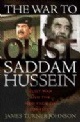
I am presently reading The War to Oust Saddam Hussein: The Context, The Debate, The War and the Future (Rowman & Littlefield, 2005), by James Turner Johnson, a notable scholar of military ethics and the just war tradition. Professor Johnson is severely critical of Bishop Wilton Gregory's stance during the Iraq war (and the subsequent position of the USCCB), because its argument against the war began with the prejudice that, in the words of Bishop Gregory, "a moral presumption against the use of armed force." According to Johnson, such reasoning is at a marked variance with the classical just war tradition:

Just war thinking in its classic form is based on something quite different -- a conception of life in political community oriented to a just and peaceful order, in which the use of armed force is a necessary tool to be used by responsibile political authority to protect that just and peaceful order in a world in which serious threats are not only possible but actual. In the presumption against war model, force itself is the moral problem, and peace is defined as the absence of the use of such force. In the just war model rightly understood, injustice and the threat of injustice are the fundamental moral problems, for in the absence of justice, the political community is not rightly ordered, and there is no real peace either in that community or in its relation to other political communities. Force here is not evil in itself; it takes its moral character from who uses it, from the reasons that are used to justify it, and from the intention with which it is used. These are, of course, the classic just war requirements of sovereign authority, just cause, and right intention, and they correspond directly to right order, justice, and peace, the goods at which political community should aim as defined in the Augustinian conception of politics within which just war tradition is soundly rooted. To be sure, force is evil when it is employed to attack the justice and peace of a political order oriented toward these goods, but it is precisely to defend against such evil that the use of force may be good. Just war tradition had to do with defining the possible good use of force, not finding exceptional cases when it is possible to use something inherently evil (force) for the purposes of good.
This post is long enough, so in the interest of time I will refer the reader to James Turner Johnson's excellent essay Just War, As It Was and Is (First Things 149 (January 2005): 14-24); George Weigel also touches upon this briefly in Force of law, law of force (The Catholic Difference April 30, 2003), and at length in his study Tranquillitas Ordinis: The Present Failure and Future Promise of American Catholic Thought on War and Peace Oxford UP, 1987.

I can't help but notice some affinities between those who praise Munich as a cinematic protest against violence (the use of force per se) and those who advocate "a moral presumption against the use of armed force" as the starting point for deliberation in matters of war. I think that a film like Munich might compel Catholics and Christians to evaluate where they stand with respect to this issue:

Is the only response to terrorism the eschewing of violence, the adoption of absolute pacifism?

Is there such a thing as a justifiable and legitimate use of armed force?

Is the 'just war tradition' as it has been developed in Catholic tradition rendered absolete, the opinion put forth by a few voices within the Vatican Curia?

With respect to the last question, I am well aware that then-Cardinal Ratzinger, in a May 2, 2003 interview with Zenit, expressed the opinion that "given the new weapons that make possible destructions that go beyond the combatant groups, today we should be asking ourselves if it is still licit to admit the very existence of a 'just war.'" Some have (incorrectly, I think) imbued this specific line with the full weight of magisterial authority, while others -- like James Turner Johnson -- have questioned its implications, as well as its reasoning.

* * *

Likewise, the question is also raised: in responding to terrorism, what is the appropriate, reasonable and morally justifiable course of action?

Are "targeted assassinations" in the prevention of terrorism acceptable? The Logic of Israel's Targeted Killing, by Gal Luft (Middle East Quarterly Volume X, No. 1, Winter 2003) describes the procedure:

Israelis dislike the term "assassination policy." They would rather use another term—"extrajudicial punishment," "selective targeting," or "long-range hot pursuit"—to describe the pillar of their counterterrorism doctrine. But semantics do not change the fact that since the 1970s, dozens of terrorists have been assassinated by Israel's security forces, and in the two years of the Aqsa intifada, there have been at least eighty additional cases of Israel gunning down or blowing up Palestinian militants involved in the planning and execution of terror attacks.
The legality of Israel's policy is presently being debated in Israeli courts. In a July 2001 State Dept. briefing, the Bush Administration stated that "Israel needs to understand that targeted killings of Palestinians don't end the violence, but are only inflaming an already volatile situation and making it much harder to restore calm." Yet, in a Fox News interview August 2, 2001, Vice President Cheney has also suggested that
"If you've got an organization that has plotted or is plotting some kind of suicide bomber attack, for example, and they have evidence of who it is and where they're located, I think there's some justification in their trying to protect themselves by preempting."
The formal position of the U.S. Government is conveyed in Executive Order 12333, signed by President Ronald Reagan, directing that "no person employed by or acting on behalf of the United States Government shall engage in, or conspire to engage in, assassination." According to the Washington Post, "the original version was signed in 1976 by President Gerald R. Ford in the wake of public disclosure in 1975 that the CIA, with White House support, had attempted assassinations in the 1950s and 1960s of Cuban President Fidel Castro and leaders in the Congo and the Dominican Republic" (Source: Walter Pincus, Washington Post 1998).

However, one can't help but note the "selective targeting" of Al Qaeda members in counter-terrorist operations (the most recent being a Pakistani air-strike which killed two senior members of Al Qaeda and the son-in-law of its No. 2 leader, Ayman al-Zawahiri (New York Times Jan. 19, 2006). How does this differ from the present strategy of Israel?

At this time, Israel is faced with the threat of Iran, a nation that has barely concealed its active seeking nuclear arms, and whose president has stated that Israel should be "wiped off the map," and "God willing, with the force of God behind it, we shall soon experience a world without the United States and Zionism."

Thursday, July 22, 2004

American Catholics and Israel

Redacted from an interview of Don Kenner, Director, Catholic Friends of Israel (CFOI) by Joseph Alexander Norland on the web page, IsraPundit

IsraPundit: Other than maintain the CFOI site, Mr. Kenner, in what activities is CFOI engaged currently?

Don Kenner: The website, the blog, letter-to-the-editor campaigns, op-eds, and contacts with lay Catholics are our main activities at the moment. We protested (faxes,emails, phone calls) a fundraiser in a Berkeley Catholic Church for the International Solidarity Movement, our position being that politics aside, no Catholic church should be raising money for an organization that aplogizes for terror. We owe this future focus of the group to a Catholic woman in California who saw the ad for the fundraiser and contacted us.

IsraPundit: Are you able to speak about your pro-Israel message in churches?

Don Kenner: There are generally two kinds of Catholic churches: those that allow political activity and those that limit on-site speakers and groups to the pastoral concerns. The former tend to be left-wing and the latter tend to avoid politics. Personally, I would rather speak to groups of Catholics in their homes, but we aren't there yet.

IsraPundit: Your site states that "We believe there are millions of Catholics who represent an untapped resource for support of the Jewish State and its right to defend itself from terrorism." To what extent have you indeed met with popular support among Catholics? Do you find that the readership of your site is increasing?

Don Kenner: I fervently believe that most Catholics in North America have sympathy for Israel's plight and justifiably see their war against terror as linked to our war. The average Catholic soccer mom who writes the checks to the local Church certainly does not support the PLO, ISM Palestinian "resistence" or any other pro-terrorist abominations. Most Catholics, and this includes many in Europe, see radical Islam for what it is: ravenous and unreasonable.

IsraPundit: What data make you believe that "Most Catholics in North America have sympathy for Israel's plight"?

Don Kenner: Most American Catholics are typically American. These lay Catholics are patriotic, suspicious of an over-reaching government, and hard line when it comes to things like terrorism. They sympathize with Israel in the same way that most Americans in general sympathize with Israel. In other words, the phrase "Most Americans sympathize with Israel" does not change when one uses the subset "Most American Catholics...".

Apart from that general observation, I also have specific indications:
- Our email box tends to confirm lay Catholics support Israel.
- Letters to the Editors: in major Catholic publications, anti-Israel material generally comes from Priests, Nun, or liberal activists/writers, while a healthy pro-Israel response comes from lay Catholics.
- Anti-Israel comments are among the most controversial things a priest can say, especially after 9-11.

Think of the Church as having three levels: 1) The Vatican/the Bishops, 2)the Middle Management (Priests, local Church and parish officials, directors of ministries, etc.), and 3) lay Catholics. There is much focus on 1), but in fact it is 2) where the problems with anti-Israel bias reside, and this "middle management" does not represent your average lay Catholic when it comes to controversial issues. This rift has been exacerbated since 9-11.

IsraPundit: Are you considering ties or collaboration with other religious groups, such as Christian Zionists?

Don Kenner: I've been the lone Catholic at a Christian Zionist conference and have always been treated with kindness and respect. However, many Protestant evangelicals regard us Papists as either fools or Satan's concubine. There is much suspicion and often the cause of a safe Israel is used as a cover for debating doctrinal issues. Don't misunderstand me: I thank G-d every day for my evangelical Christian brothers. On both Israel and many other issues we share common ground. I hope that ALL supporters of Israel can work more closely together in the future.

I often find myself defending Protestant fundamentalists to my fellow Catholics, and just as often defending my Church against wild, conspiratorial accusations by both Protestant and Jewish activists. Here's a recent one: the Vatican is manipulating Arab opinion to effect an Arab-Christian take over of Jerusalem so that Rome can, once again, control this holy city. I hope everyone reading this interview can see past this, but I've twice had this put to me and been dared to deny it. Needless to say, the last person who suggested such a thing was Franco, and the idea was rejected.

Realize this: the same news organizations that write outrageous falsehoods about Israel also apply the same lack of professionalism and ideological rigor to their coverage of the Catholic Church. Often it's the very same commentator. When James Carroll divined that the essence of Catholicism was antisemitism, many of our Jewish friends nodded in assent, but when the same James Caroll compared the cutting down of olive trees with suicide bombings, they were less impressed with his acumen. We were not surprised to see the anti-Catholic bigot beating up on the Jewish state. (See CFOI article dated March 20, 2004.)

IsraPundit: How did you research the Israel/Arab conflict so as to become a pro-Israel advocate?

Don Kenner: Twenty years ago I believed in a one state solution (Palestine) and thought insane anyone who considered the Jewish state a permanent entity. Everyone I knew believed this, so it made sense. But even at the time I knew my knowledge of the Arab-Israeli conflict was limited to a few Chomsky-like platitudes. So how did I change?

This may sound strange, but after a period of ignoring the whole Mid East conflict, it was my conversion to Catholicism that set me on the road to Zionism and clear-headed thinking about the Jewish state. The example of the Holy Father with regards to Catholic-Jewish relations, coupled with the simple admonition that Catholics are called to seek the truth, set me on this course.

IsraPundit: A news story in Ha'aretz, 7 July 2004, reported that "The Catholic Church condemned anti-Zionism as a cover for anti-Semitism by means of a joint statement issued by a forum of Catholic-Jewish intellectuals this week." How significant do you deem this statement in terms of changing the official Catholic anti-Israel stance?

Don Kenner: Since the signing (ten years ago) of the Fundamental Agreement between Israel and the Holy See, I don't think there has been anything like an 'official Catholic anti-Israel stance'. The statements from the Vatican, from Bishops, and from other Catholic leaders have been varied and uneven, with the most positive declarations coming from Pope John Paul II. There have been many sad and ridiculous statements from Catholic Bishops, statements that are rarely criticized by Jewish leaders in the U.S. (A little help, please!!).

As to equating of anti-Zionism with anti-Semitism, it is on target and overdue. There have been other indications that the pro-Israel (or at least not pro-Palestinian) forces in the Church were making their views known. As you might imagine, we at CFOI are elated with the statement.

IsraPundit: Will this statement have any impact on such practical issues as Israel's security barrier, which a gathering of Catholic bishops condemned?

Don Kenner: I regard the American Catholic participation in that one-sided, insensitive, ahistorical, and morally inane statement against Israel's security barrier to be the lowest point in the history of the US Conference of Catholic Bishops. What we need is a declaration by courageous, faithful Catholics that the Jews have a natural right to defend themselves from terrorism, consistent with Catholic teachings on subject. Too many hard politicos of the left have carved out a pro-Palestinian trench in our Churches. A little sunlight is the best disinfectant.

IsraPundit: Do you support the so-called "two-state solution"?

Don Kenner: Israel acquired the disputed territories from invading Arab countries. If she wishes to trade some of it away to achieve security, it would seem silly for a bunch of Catholics to protest. However, I believe that the land-for-peace scheme has been an unmitigated failure, precisely because the so-called peace partners want to liberate "occupied Tel Aviv."

IsraPundit: Thank you, Don, for this interview. For the sake of Israel and for the sake of our own democracy in North America, I hope that your organization is successful

Thursday, July 1, 2004

Catholic Friends of Israel - Statement of Principles

Catholic Friends of Israel was founded by Don Kenner in 2004, adopting the following statement of principles:
  • We are faithful Catholics who support the only democracy in the Middle East, Israel.
  • We are faithful Catholics who wish to draw more attention to the plight of long-suffering Catholics and other Christians in the Muslim world.
  • We are men and women of the Roman Catholic faith who are mindful of the resurgence of virulent anti-Semitism. We want our Church to be on the right side of the most important issue for Catholics in the 21st century.
  • We are not a dissident organization. We accept the teachings of the Church. Our organization is not a front group to promote a single issue under the guise of Catholicism (e.g., "Catholics for Choice").
  • We believe there are millions of Catholics who represent an untapped resource for support of the Jewish State and its right to defend itself from terrorism.
  • We want to be a source of information for Catholics on the Arab-Israeli conflict, monitor anti-Israeli bias in the Catholic press, and resist attempts to politicize our sacred liturgy with a pro-Palestinian spin.
  • We take as our starting points:
    • 1) The work of the Holy Father John Paul II in promoting respect and mutual understanding with our "elder brothers" the Jews,
    • 2) the positive changes in Catholic-Jewish relations since Vatican II, and
    • 3) the Fundamental Agreement between the Holy See and the Jewish State.
  • Catholic Friends of Israel does not endorse any political party, but does comment on candidates, platforms, policy positions, and elections, while being ever-mindful that Catholics consider a variety of issues when voting.

Wednesday, January 28, 2004

The Bishops and the Suicide Bomber

"The Bishops and the Suicide Bomber" -- Originally published by FrontPageMagazine.com | Wednesday, January 28, 2004.

Filmmakers tell us that the impact of a scene lies not in a single shot, but rather in the juxtaposition of two shots; the contrast of viewing each in succession provides an experience that adds up to more than the sum of its parts. Life also has these moments, when the juxtaposition of events reveals more than any one experience ever could. Two recent events tell us much about how the Arab-Israeli conflict is viewed.

First, American and European Bishops began a four-day meeting in the Holy Land, presided over by Latin-rite Patriarch Michel Sabbah. The purpose of their visit was to express solidarity with the Church of the Holy Land, and to reiterate grave concerns over the security measures taken by Israel in the face of a prolonged terrorist war.

Second, a female suicide bomber (and mother of two) took advantage of Israel’s soft policy towards Palestinian females, feigning metal plates in her legs in order get inside the checkpoint between Israel and the Gaza Strip. When a female soldier went to help her, she blew herself up, killing four Israelis and wounding nine others.

The next day a statement from the Bishops denounced not only the anti-terrorism fence, but also checkpoints, visa restrictions, and other inconveniences. Did they blame these sometimes harsh but necessary constraints on those who use mass murder as a tool of diplomacy? No, they blamed the state of Israel.

In the Catholic faith, the State derives the right to use lethal force from Natural Law, and is required to wield it to protect her citizens. Failure to do so is a moral failure. But the Jewish State is criticized harshly by American and European Bishops even when it uses non-lethal means to protect citizens from a terrorist war. Given that both the Bishops and European governments (to say nothing of the U.S. State Department) have vociferously criticized Israel for targeted killings of terrorist leaders and risky house-to-house searches for terrorists, it isn’t clear what Latin-rite Patriarch Michel Sabbah and USCCB President Wilton Gregory would consider acceptable methods to prevent soldiers, women, children, and even Holocaust survivors from being blown to bits, shot in the head by snipers, or beaten to death with heavy rocks. Since such horrific violence predates the anti-terrorism fence (as well as the settlements), it is difficult to fathom why the Bishops see either of those issues as the difference between bodies strewn across a crowded market place and peace in our time.

Reasonable people can disagree over whether the anti-terrorism fence is an effective method to reduce terror aimed at civilians as well as soldiers. What is not reasonable is the insistence that Israel do nothing serious in the face of an enemy that has pledged to destroy the Jewish State and whose leaders still speak of liberating “occupied Tel Aviv.”

History provides the context whereby moral judgments are made about nations. But the statement released by the Bishops was written in a moral and historical vacuum. Rather than a small, besieged country that has faced four Arab wars aimed at its annihilation, Israel is that country which is building the dreaded fence, a humiliating barrier more soul-destroying than a bomb in a pizza parlor or grenades tossed into a Bar Mitzvah. Instead of a country that only ten years ago offered the Palestinians virtually all of the disputed territory acquired in 1967 from an invading Jordan (only to have the offer rebuffed in favor of a new and deadlier Intifada), Israel is the country that is building a “permanent structure” which is “dividing families” and isolating Palestinians “from their livelihood.” There is nothing in the Bishops’ statement about how Palestinian livelihood is affected by terrorism, the Palestinian Authority dictatorship, or virulent, institutionalized anti-Semitism.

The next paragraph is worth quoting in full:

“We have had an experience of the frustration and humiliation undergone everyday by Palestinians at checkpoints, which impede them from providing for their families, reaching hospital, getting to work, attending studies and visiting their relatives.”

In a sad and tragic act of irony that says more than any press release could, shortly before the Bishop’s statement was released a female Palestinian terrorist showed all with open eyes exactly what the checkpoints (and the fence) are designed to prevent.

The Bishops’ statement of solidarity ends with the rallying cry “You are not alone!” One might ask, alone in the face of whom? There aren’t many actors in the Bishops’ drama. Arab countries, terrorist groups, and this month’s Palestinian leader do not figure into the moral calculus. Hebrew Catholics (and their Bishop) were evidently not invited or else declined to attend. Are the Bishops really suggesting that the Church in the Holy Land become another group raising its fist in defiance of the “Zionist entity?”

Michel Sabbah and the Catholic Bishops have given us a simplistic and all-too-European scenario in which the Jewish State is stealing land and preventing decent folk from work and worship. In doing so they have eschewed the difficult moral issues of unfinished terrorist wars, resurgent world-wide anti-Semitism, Islamofascism, and the right of democracies to defend their people from all of the above. These are only the most important issues facing the world today. Catholics deserve better from their leadership.